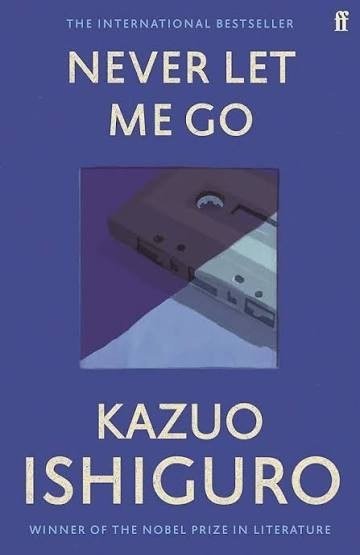
I read this not long after finishing Never Let Me Go for the first time and i went in expecting something similar, another quiet devastating book about beings who are not quite considered fully human and what that does to the people and things around them. What i got was similar in spirit but completely its own thing, and i think it might be even more affecting in certain ways because of how directly it is told.
Klara is an AF, an Artificial Friend, a companion robot designed to keep lonely children company in a near future America where genetic editing has created sharp divides between children who have been improved and those who have not. She begins the book in a shop, watching customers and passersby through the window with the patient hope that someone will choose her. Ishiguro writes this section with such care that you understand immediately how Klara's mind works, how she observes and reasons and hopes, all in a voice that is innocent without being naive.
She is eventually chosen by Josie, a sickly girl, and brought home to be her companion. What follows is the slow unfolding of Klara's devotion to Josie and to Josie's mother, and the increasingly complicated situation Klara finds herself navigating as Josie's illness and the family's plans for her future become clearer. I do not want to say too much about where this goes because the slow reveal of what is actually happening, and what Klara is eventually asked to consider doing, is one of the most quietly devastating things i have read in recent fiction.
What makes Klara such a remarkable narrator is the specific quality of her attention. She notices everything and processes it through a logic that is not quite human but is trying very hard to understand humans. She develops a belief, almost a kind of private faith, that the sun has healing power, and the way this belief develops and the role it plays in the choices she eventually makes gives the book an unexpected emotional and almost spiritual dimension. I went into this expecting a cool clever science fiction premise and came out having been moved in a way i did not anticipate.
The supporting human characters are drawn with the same precision Ishiguro always brings to his work. Josie's mother, in particular, is a complicated and not always likeable presence whose own grief and fear shape decisions that ripple through the whole story. Ishiguro never explains her motivations directly. You have to read her through Klara's careful but limited understanding, which means you end up doing some of the emotional work yourself, piecing together what an adult human is actually going through from the outside observations of someone who does not fully share human assumptions.
The wider world of the novel, the genetic editing of children and the social and economic divide it creates between the lifted and the unlifted, is sketched only at the edges. Ishiguro gives you just enough to understand the stakes without ever fully explaining the mechanics or the politics of how this world works. I wanted more of this at times, more concrete detail about how society actually functions around these divisions, but i understand why Ishiguro chose to keep it impressionistic. The book is not really about world building. It is about what Klara comes to understand about love and sacrifice, and broadening the focus too much would have diluted that.
The ending is restrained in exactly the way Ishiguro's endings always are, quiet and devastating rather than dramatic, and it recontextualizes everything that came before it once you understand the full shape of what Klara has done and why. I sat with the book closed in my lap for a while after finishing it, which is the response Ishiguro seems to be specifically built to produce in his readers. Five stars.