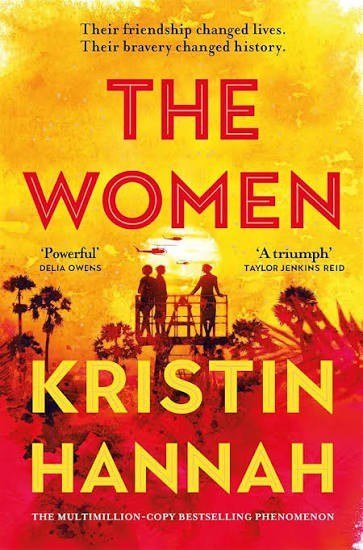
They come from different backgrounds and respond differently to the war, but their friendship is practical before it is sentimental. They teach Frankie, cover for her, tell her when she is being foolish, and remain connected after returning home. The title is plural for a reason. Frankie is the central figure, but Hannah is trying to restore a larger group of women to a war story that often excluded them.
The Vietnam sections move quickly and Hannah is effective at making medical work dramatic without turning every patient into an individual subplot. The details of heat, mud, incoming attacks, helicopters, shortages, and the constant movement between terror and routine create a strong setting. The romantic storylines are more familiar. Frankie becomes involved with men whose availability is complicated, and some of the emotional turns can be predicted long before she recognizes them.
The second half is the reason the book matters more than a conventional wartime romance. Frankie returns to the United States expecting difficulty but not erasure. She is met by protest, family discomfort, and the repeated statement that there were no women in Vietnam. Veterans' services are organized around men. Her parents prefer silence. The skills that made her essential in a field hospital do not translate into respect at home.
Hannah writes Frankie's post-traumatic stress directly. She drinks, experiences flashbacks, makes destructive choices, and repeatedly tries to return to the person she was before the war. The novel is strongest when it shows that this person no longer exists and that the demand to become her again is part of the harm. Frankie does not simply need rest. She needs language, treatment, and acknowledgment.
I appreciated that recovery is not immediate. Friendship helps, but it does not solve everything. Love helps, but it is not presented as medical treatment. Frankie has relapses and makes decisions that frustrated me, especially in her romantic life, yet those decisions are connected to loneliness and the desire to be recognized by someone who understands where she has been.
At the same time, the plot becomes increasingly melodramatic. Important men return, disappear, reveal secrets, and reappear with timing that feels designed to keep the emotional pressure high. One late reveal in particular pushed my patience. It creates a powerful scene, but it also depends on coincidence and withheld information in a way that reminded me i was reading a carefully engineered novel.
Frankie's parents are also drawn in broad strokes for much of the book. Their shame and denial reflect real cultural attitudes, but they sometimes function mainly as obstacles until the story is ready to soften them. I wanted more complexity in how a family that celebrated military service could refuse the form their daughter's service took.
Book Summary
Frances McGrath grows up in a conservative California family that honors military service but imagines heroism as male. After her brother leaves for Vietnam, Frankie joins the Army Nurse Corps and is sent into a war for which she is emotionally unprepared. Under extreme pressure she becomes a skilled surgical nurse and forms life-saving friendships with fellow nurses Barb and Ethel. Returning home proves to be a different battle: the country is divided, her family wants silence, veterans' systems overlook women, and strangers insist that women were not in Vietnam. The novel follows Frankie's war service, trauma, addiction, relationships, and uneven recovery while restoring women nurses to the public memory of the conflict.
What I Liked
The first half creates a convincing sense of nursing under impossible conditions. Frankie's growth is not described only as courage. It is technical competence learned through exhaustion, repetition, mistakes, and the example of more experienced women. That makes her transformation feel earned.
Barb and Ethel are the relationships i trusted most. Their friendship continues across distance and relapse, and they can support Frankie without idealizing her. The novel is also strong on the specific cruelty of erasure. Frankie returns with real medical skill and trauma, yet is repeatedly told that women did not serve in Vietnam. That denial becomes a second injury.
What Could Be Better
The romantic plotlines rely heavily on secrets, bad timing, and dramatic returns. Several turns are visible early, while a late reveal feels engineered to produce maximum shock rather than growing naturally from the characters. These elements sometimes pull attention away from the more original story of women nurses and veteran care.
Frankie's parents are emotionally effective but not always nuanced. Their denial represents a social reality, yet their behavior can feel arranged to isolate Frankie as completely as possible.
Context Behind the Book
Kristin Hannah is an American novelist and former lawyer known for emotionally direct stories about women living through war, disaster, family conflict, and historical change. Her widely read novels include The Nightingale, The Great Alone, and The Four Winds. The Women continues her interest in placing a woman inside a part of history commonly narrated through men, this time focusing on American military nurses in Vietnam and the difficulties they faced after returning home. Hannah's work combines extensive historical settings with accessible family drama and strong female friendships. Her novels often reach readers who may not usually choose historical fiction because the history is carried through intimate relationships and survival.