
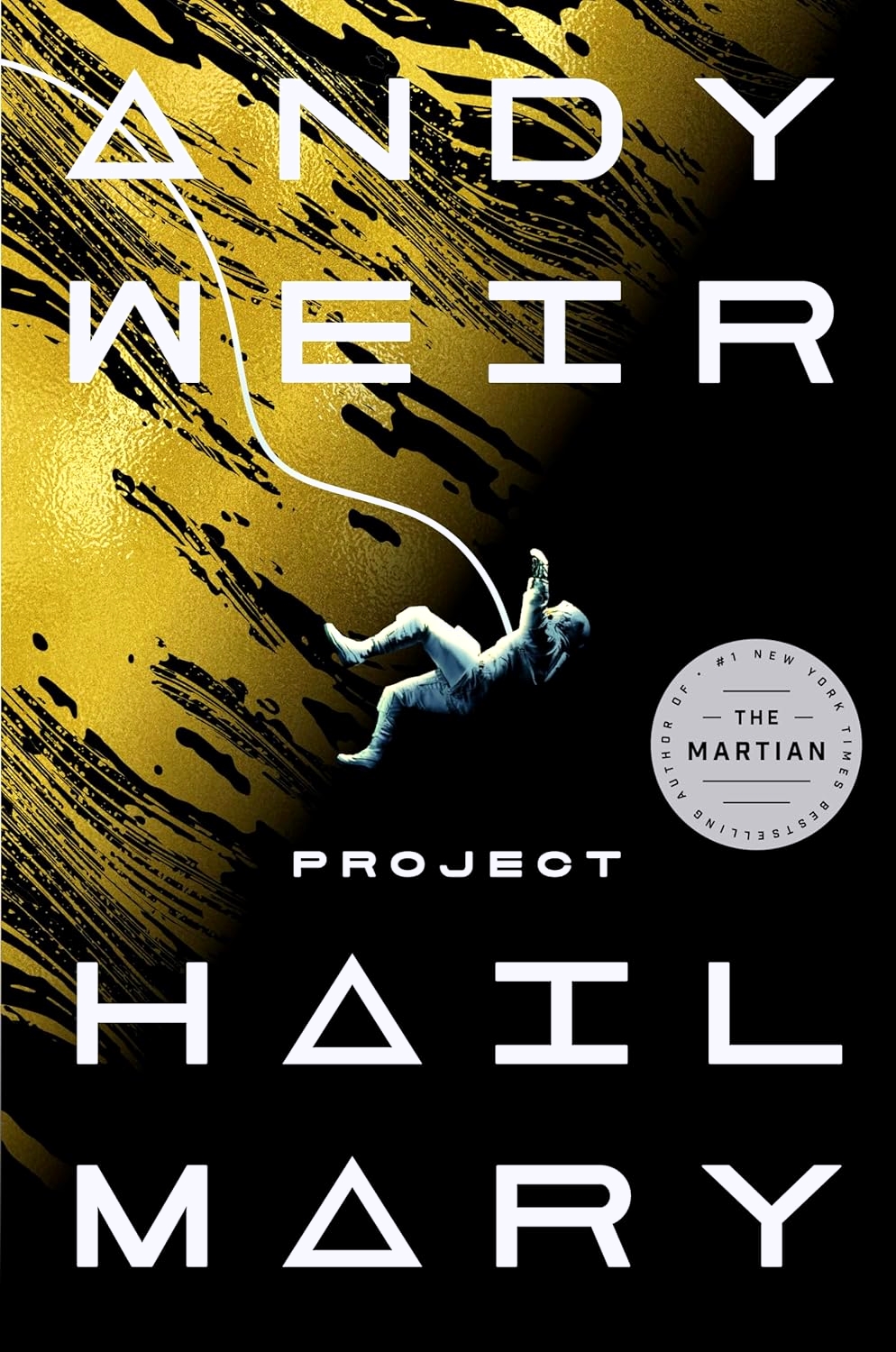
Project Hail Mary Review
| Published | 2021-05-04 |
| Series | Standalone |
| Genre | Science Fiction, Space Adventure, Thriller |
| Language | English |
| Publisher | Ballantine Books |
| ISBN-10 | 0593135202 |
| ISBN-13 | 978-0593135204 |
📝Project Hail Mary — My Honest Review
Written and reviewed by Shadab Alam. The opinions and rating in this review are my own.
Summary:
Ryland Grace wakes alone on a spacecraft with no memory of his name, his mission, or the two dead crew members beside him. Slowly he learns that Earth is being threatened by Astrophage, an organism draining energy from the sun, and that he has been sent to Tau Ceti to discover why that star remains unaffected. His mission appears impossible until he encounters Rocky, an engineer from another intelligent species facing the same disaster. The two must create a shared language, understand radically different biology, and combine their knowledge before both worlds run out of time. The novel mixes scientific problem-solving, first contact, memory, and an unexpectedly warm friendship.
✅ What I Liked
The communication between Grace and Rocky is the best part of the novel. Weir does not allow them to understand each other instantly. They begin with numbers, physical demonstrations, repeated sounds, and the slow construction of meaning. The process is funny and moving because communication itself becomes an act of trust.
The scientific problems are also presented with real narrative energy. Grace rarely solves anything on the first attempt, and failure produces the next question rather than simply delaying the plot. Even when i did not follow every calculation, i understood what was at risk and why the solution mattered.
I also liked the way the returning memories change Grace's view of himself. The amnesia begins as a mystery device, but it eventually becomes a moral one. The final choices have weight because the novel has separated being intelligent from being brave and then asked whether Grace can become the person he initially assumed he was.
❌ What Could Be Better
Grace's voice is very close to the familiar Andy Weir hero: technically brilliant, verbally casual, and constantly ready with a joke. It is entertaining, but readers who found Mark Watney irritating may have the same problem here. Several jokes are repeated until they lose some effect.
The flashback characters are drawn mainly according to their jobs in the crisis. Eva Stratt is memorable, but she often feels more like the embodiment of emergency authority than a complete person. The amnesia also returns information with suspiciously perfect timing, which makes the structure feel engineered even when the revelations are effective.
There are sections where the explanation continues after the dramatic point has already landed. Weir wants the reader to understand the experiment, not just the result, and that is part of the appeal, but a few chapters could lose several paragraphs without losing clarity. Rocky is so immediately lovable that the novel occasionally makes interspecies friendship easier emotionally than it is scientifically.
Grace eventually realizes he is alone on a spacecraft in another solar system. Earth is facing an extinction-level problem caused by Astrophage, a microscopic organism that feeds on stars and is reducing the amount of energy reaching the planet. The Hail Mary mission has been sent to Tau Ceti because that star appears resistant. Grace's job is to understand why and send the answer home. The difficulty is that he cannot initially remember agreeing to any of this.
The novel moves between the present mission and returning memories of the years before launch. This structure works because the past is not simply explanation. Each memory changes what Grace believes about himself. He begins with the idea that he must have been the brave scientist chosen to save humanity, and the truth is more complicated. Weir is better here than he was in The Martian at giving the technical problem-solving a personal consequence.
The science is the main attraction. Grace calculates gravity, tests materials, studies biology, improvises equipment, and explains almost every step. There are pages where the book is basically a classroom demonstration with life-or-death stakes. I enjoyed most of this because Weir is very good at turning a solution into a small narrative victory. The method is repetitive by design: problem, experiment, failure, new idea, solution, larger problem. Readers who dislike technical explanation will know very quickly that this is not the book for them.
Then Grace discovers he is not the only intelligent being trying to solve the same crisis. Rocky, an engineer from another species, is the element that takes the novel beyond a more elaborate version of The Martian. Their first attempts at communication are some of the best scenes in the book. Neither can assume shared language, biology, atmosphere, senses, or even basic physical habits. They have to build understanding from numbers, sound, observation, and patience.
Rocky is also extremely likeable, perhaps almost too likeable, but i did not mind. The friendship gives the story warmth that Grace alone would not have provided. Weir makes cooperation feel exciting. Their differences create practical danger, but the novel is fundamentally optimistic about the possibility that two intelligent beings can choose curiosity over fear. In a genre that often begins alien contact with weapons, it was refreshing to read one where the first instinct is to compare tools.
Grace's personality is familiar if you have read Andy Weir. He is funny under pressure, highly competent, and inclined to explain his thinking out loud. Some jokes land and some feel like the same voice used for Mark Watney with slightly different circumstances. The supporting characters in the flashbacks, especially Eva Stratt, have strong functions but limited inner lives. Stratt is ruthless because the crisis requires ruthlessness, and the novel rarely pauses to examine what that power does to her.
The amnesia device is useful, though it is also visibly useful. Information returns at exactly the moment the plot needs it, and after a while i stopped believing in the medical randomness of the memories. I accepted it because the revelations are effective, particularly the one that redefines Grace's presence on the mission, but the mechanism remains a mechanism.
What surprised me was the emotional weight of the final third. The book keeps asking what heroism actually means when nobody is present to witness it and when every available choice harms someone. Grace's first idea of himself is built around intelligence. His later choices are about loyalty, fear, and the kind of person he wants to be after learning what kind of person he has already been.
The ending is satisfying and a little strange in exactly the right way. Weir follows the consequences of Grace's decisions rather than forcing the story back toward the most conventional version of success. It is sentimental, but the sentiment has been earned through the practical intimacy of two beings keeping each other alive.
Four and a half stars. The dialogue can be broad, the humor repeats, and the science explanations occasionally continue after the point is already clear. But the central friendship, the steady escalation of problems, and the genuine pleasure of watching intelligence become cooperation made this difficult to put down. It is one of the rare long science-fiction novels that feels fast because every chapter ends with a new reason to keep going.
📊Shadab's Rating
🎭Vibe Check
Read spoilers, debates, and detailed user reviews in our discussion room.
Discover Your Next Great Read
Handpicked recommendations from our collection of literary treasures