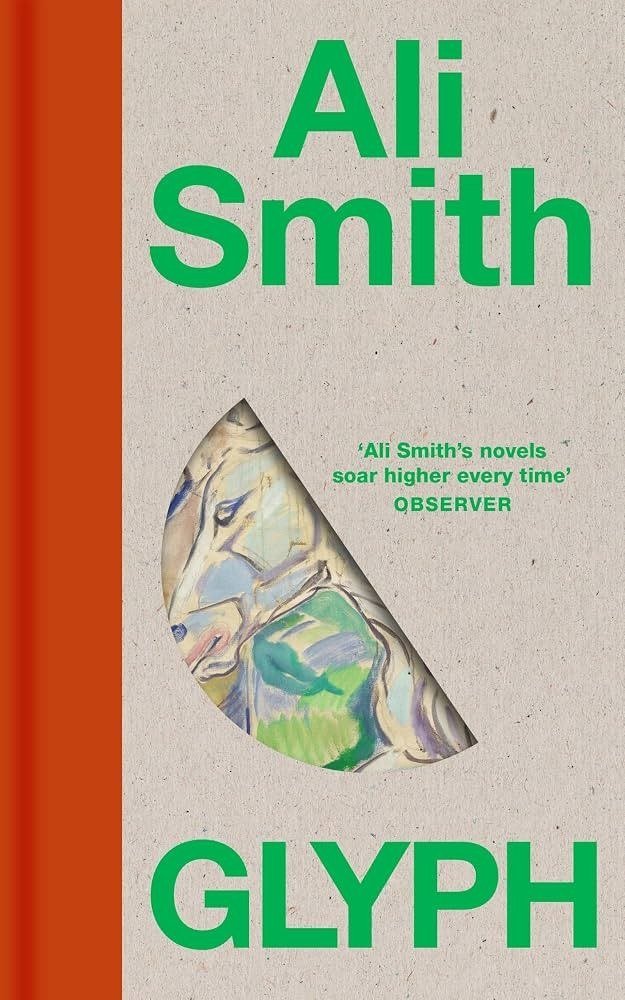
Glyph book cover by Ali Smith
⏱️
Estimated Read Time
5–7 hours

Glyph Review

✍️ Book by Ali Smith
Editorial Rating
★★★★☆ 4.3
Epiloguely review by Shadab Alam
Reader Rating
☆☆☆☆☆ 0.0
No reader ratings yet
Rate This Book
A written review is optional
Published2026-01-29
SeriesGliff / Glyph interconnected pair
GenreLiterary Fiction
LanguageEnglish
PublisherHamish Hamilton
ISBN-100241665590
ISBN-139780241665596

📝Epiloguely Editorial Review

Written and reviewed by .

Glyph is one of those books where trying to explain the plot too neatly almost gives the wrong impression. There are sisters, ghosts, a phantom horse, childhood memories, war stories, artificial intelligence, political protest and arguments about language. All of those things matter, but Ali Smith is much less interested in arranging them into a conventional mystery than in asking why certain stories refuse to disappear.

At the center are Petra and Patch, two sisters whose relationship begins to take shape around something horrifying they hear as children. Faced with stories about war and death that are far beyond what they know how to process, they invent Glyph, a ghost who becomes part game, part protection and part way of giving shape to something unbearable. The idea sounds whimsical when described that way, but there is always something darker underneath it. Children are being handed fragments of violence created by adults and trying to find a language that makes those fragments survivable.

That childhood bond becomes more complicated when the novel moves forward decades. Petra and Patch are no longer close. Their shared imaginative world belongs to another version of their lives, until Petra encounters something she cannot easily explain: a horse that appears inside her bedroom as though the past has suddenly found a physical way back into the present.

For me, the relationship between the sisters is where the book feels most human.

Smith can be extremely playful with language, structure and reference, but Petra and Patch give all that experimentation somewhere emotional to land. Their history is affectionate without being simple. They have survived the same family and remember some of the same events, yet memory has not left them in the same place. The distance between them matters because the novel is interested in what people inherit from the past even when they would rather move on.

The ghostly material works in much the same way. I never felt that the central question was whether the horse or Glyph should be understood literally. Smith seems far more interested in what a haunting does. Something from the past arrives and forces attention. It refuses the convenience of being finished.

That becomes especially important once the novel moves outward from private memory toward war and political violence.

Glyph is openly an anti-war novel.

It links historical violence with present-day conflicts and repeatedly asks what it means to witness suffering through screens, headlines, fragments of language and political statements. Contemporary reviewers have especially noted the novel's engagement with Gaza, as well as its broader concern with Ukraine, state power and the language used to distance people from violence. The Guardian

This could easily have become heavy-handed, and occasionally I think it does. Smith is not trying to hide her anger. The novel is suspicious of euphemism, passive language and the kind of political phrasing that can make dead people sound like administrative outcomes instead of human beings.

At its strongest, she does not need to explain that point. A damaged body, a frightened child, an injured horse or a phrase that suddenly sounds wrong can carry the argument by itself.

Those were the moments I liked most.

Language itself becomes one of the book's major subjects. The title matters because a glyph is a mark that carries meaning. Smith keeps returning to words, symbols, writing, storytelling and the way meaning survives or mutates over time. That gives the novel an unusual connection between something ancient—a mark scratched or pressed into a surface—and the speed of modern communication, where wars, political claims and human suffering can arrive as captions, posts and fragments on a screen.

The book seems to ask what kind of mark any of this leaves on us.

That question is stronger than the more direct political statements because it connects the formal play of the novel to its moral concerns. Stories are not harmless decorations here. They can preserve memory, distort it, refuse it or force someone to see what they were trying not to see.

Smith's use of imagination is especially interesting because the book does not treat fantasy as escape in the simple sense. When Petra and Patch invent Glyph as children, imagination helps them survive frightening knowledge. As adults, imagination becomes a way of reopening what has been buried. It offers comfort, but it also makes avoidance harder.

Billie, Patch's teenage daughter, helps pull the older characters into the present. She brings another generation into the argument about politics, language and responsibility, and her presence prevents the book from becoming purely nostalgic about childhood or memory. The past matters, but the novel is constantly asking what people are doing now with what they know.

I liked that generational friction, although Smith's younger characters can sometimes sound unusually alert to every hypocrisy around them. That is part of her style, and it gives Billie energy, but there were moments when I could feel the author speaking through the character more clearly than I wanted.

I had a similar reaction to some of the material about artificial intelligence. The subject fits the novel's interest in language, imitation and what separates human creation from mechanical production, but some of the statements are far less subtle than the ghost story or the sibling relationship. Publishers Weekly raised a similar reservation, describing parts of the AI commentary as obvious and somewhat didactic. PublishersWeekly.com

That difference is important because Smith is at her best when meaning arrives indirectly. A strange image can sit in the mind for pages. A word can change depending on where it appears. Something remembered from childhood can suddenly acquire political meaning thirty years later.

When the novel simply tells me what it thinks, some of that electricity disappears.

The structure may also frustrate readers looking for conventional plot momentum. Glyph moves through memory, association, language and recurring images rather than building toward a clean sequence of revelations. One contemporary review called attention to how deliberately plot-light the novel can feel, and I understand that reaction. The Spectator

But I do not think conventional suspense is what Smith is after.

The novel accumulates rather than advances.

A horse appears. A wartime story returns. A phrase echoes something said earlier. Political violence in one period begins to resemble violence in another. Two sisters remember being children, but their memories do not stay safely in childhood.

That accumulation eventually becomes the point.

What I found most effective was the refusal to separate private grief from public history. A family story is never only a family story because the language, fears and assumptions surrounding that family come from somewhere. At the same time, huge historical events eventually become private because actual people have to carry what happened.

The novel's anger is therefore not abstract. Smith keeps bringing it back toward individual bodies, memories and acts of care.

That last part matters because Glyph could otherwise become overwhelmingly bleak. For all its attention to war, repression and the failures of language, it still believes in connection. Petra calls Patch. People care for one another badly, imperfectly and sometimes too late, but they still do it. Imagination can distort reality, yet it can also create enough room for someone else to enter.

That is probably why the book did not feel hopeless to me.

I did not respond equally to every experiment. Some political observations are stated more directly than they need to be, the AI material occasionally feels attached to the novel's argument rather than fully absorbed into it, and readers who want a strong conventional plot may find the movement frustrating.

But the sister relationship kept bringing me back.

So did the horse.

And so did the idea of a glyph itself: a mark left behind because someone, somewhere, needed something to remain visible.

Book Summary

Glyph begins with Petra and her younger sister Patch hearing disturbing stories about war when they are children. Unable to make sense of what they have been told, the sisters invent a ghost they call Glyph, turning imagination into a way of living with something too frightening to understand directly. Decades later, Petra and Patch are estranged, and the old story seems safely buried until Petra finds herself confronted by an impossible horse in her bedroom and calls her sister for help. Their reunion brings childhood memory, family damage, war, language, political violence, and the stories people tell to survive into the same uneasy space. The novel is connected to Gliff, but it works on its own as a strange, playful and often angry examination of what history leaves behind and what happens when people decide not to look away.

What I Liked

The relationship between Petra and Patch gave the book its strongest emotional center for me. Their childhood imagination, later estrangement and eventual reconnection keep the novel grounded even when Smith moves into war, ghosts, politics and linguistic experimentation. I also liked the recurring images, especially the phantom horse, because they allow the past to intrude without turning the story into a straightforward supernatural mystery. Smith's wordplay is not merely decorative either; the novel repeatedly connects the way language is used with what people are willing to see, remember or ignore. The quieter scenes of care worked particularly well because they offered resistance to the violence surrounding the characters without pretending that kindness can simply erase it.

What Could Be Better

The novel occasionally becomes too explicit about ideas that its imagery has already communicated more effectively. I felt this most strongly in some of the commentary on AI and contemporary politics, where the argument can move ahead of the characters. The fragmented structure may also make the novel feel almost plotless to readers expecting the ghost and phantom horse to develop into a conventional mystery. I generally liked Smith's formal freedom, but there were places where another layer of restraint would have allowed the emotional and political material to land with greater force.

Context Behind the Book

Ali Smith is a Scottish novelist and short-story writer born in Inverness in 1962. Her work is known for formal experimentation, wordplay, political immediacy and an interest in how art changes the way people understand time and one another. Her books include Hotel World, The Accidental, How to Be Both, Companion Piece and the four novels of the Seasonal Quartet. She has been shortlisted for the Booker Prize four times and has won the Women's Prize, Goldsmiths Prize, Costa Novel Award and Orwell Prize for Political Fiction. Glyph follows the interconnected Gliff but is designed to stand independently as well. Penguin

Sources & References

Reader Reviews

0 published written reviews · Reader star ratings remain separate from the editorial rating.

No reader reviews yet Be the first reader to share a thoughtful review of at least 100 words. A quick star rating can still be submitted separately above.

📊Reader Rating Breakdown

0.0
★★★★★
No reader ratings yet

No reader ratings yet. Be the first reader to rate this book using the separate quick-rating stars above.

🎭Vibe Check

What's the vibe of this book?
💬 Open Reader Comments & Discussion

Use the separate comment-style discussion room for spoilers, endings, characters, theories, questions, and replies. Formal reader reviews stay on this page.