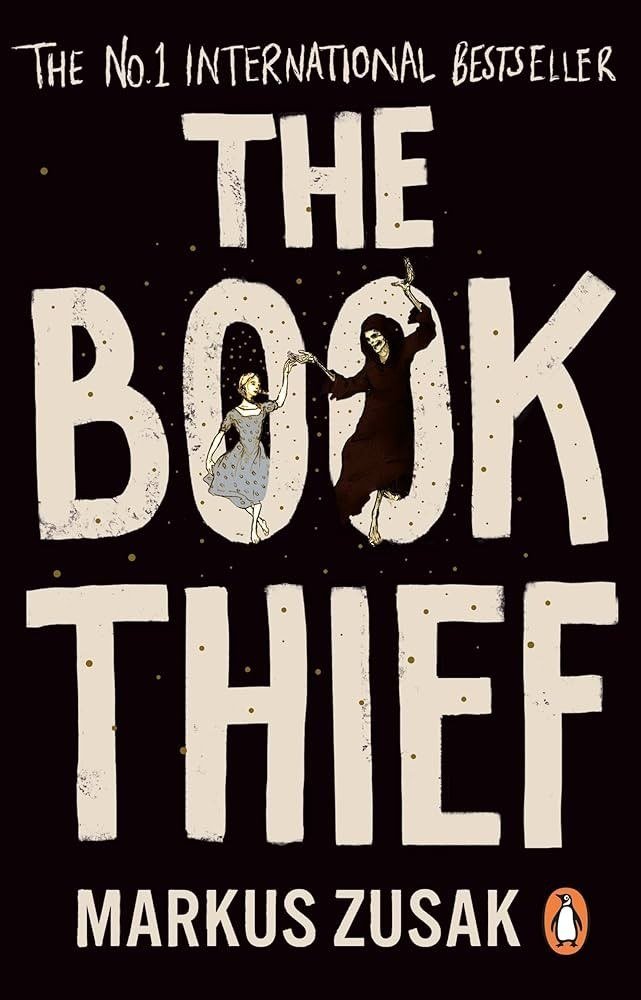
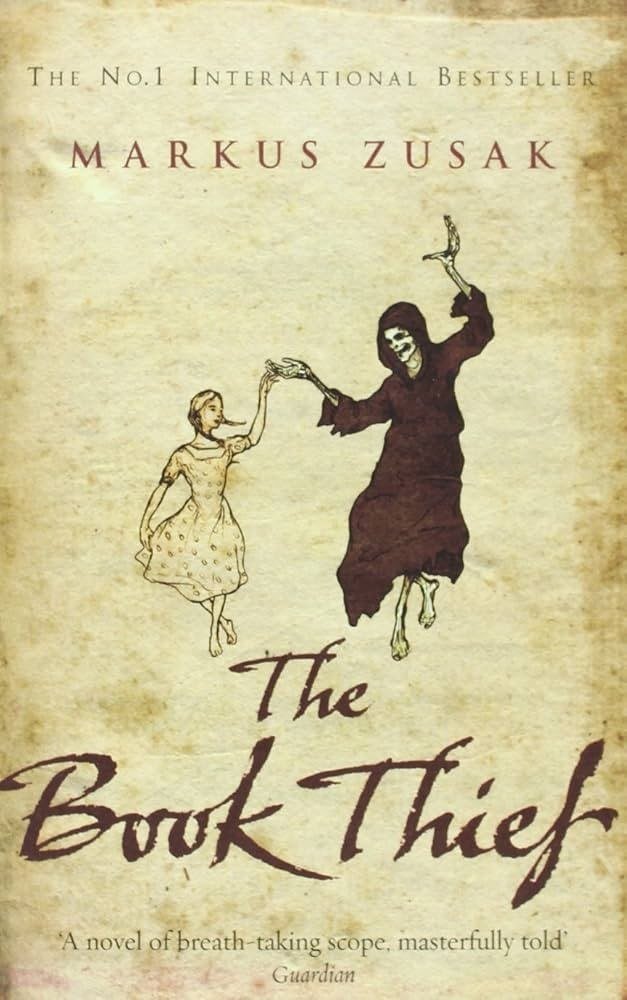
The Book Thief makes its boldest choice before Liesel Meminger has even properly entered the story: Death will be the narrator. In another novel, that device could easily become distracting or theatrical, but Markus Zusak gradually turns Death into the ideal witness for a story set in Nazi Germany. He is everywhere humans are dying, yet he remains fascinated by the contradictory creatures whose souls he collects. His voice gives the book distance from its horrors while also making those horrors feel impossible to escape.
Liesel begins the novel without the ability to read, which makes her relationship with books more meaningful than simple literary enthusiasm. Her first stolen book matters before she can understand its words because it is tied to the death of her brother and the disappearance of her old life. Hans Hubermann’s patient nighttime reading lessons transform language from something inaccessible into a form of intimacy. As Liesel becomes a reader, books become a way to remember, resist, comfort others, and eventually tell her own story.
Hans is one of the novel’s warmest characters, but Zusak wisely does not make kindness easy for him. His decency carries real danger in a society where helping the wrong person can destroy an entire family. His decision to shelter Max Vandenburg grows from an old promise and a personal sense of obligation, yet it also forces Rosa and Liesel into the same risk. The novel is strongest when morality is presented not as an abstract belief but as something that has consequences for the people standing beside you.
Max gives the book another understanding of words. Forced to hide in a basement while the country around him is systematically persecuting people like him, he creates stories and images from materials connected to Nazi propaganda. That act turns language into a battleground. Hitler’s power depends partly on words capable of organizing fear and hatred, while Liesel and Max use words to create friendship, memory, imagination, and small private spaces that the regime cannot completely control.
Rudy Steiner keeps the novel from becoming emotionally one-note. His friendship with Liesel contains teasing, jealousy, competition, affection, childish foolishness, and loyalty. Their relationship reminds us that children continue being children even inside historical catastrophe. Zusak repeatedly places ordinary desires beside enormous political violence, and that contrast is one of the reasons the book can be so painful: the characters are not living inside a history lesson but inside lives that still contain football, schoolyard arguments, crushes, hunger, jokes, and stolen apples.
The novel’s style is also its most divisive feature. Death frequently interrupts the narrative, reveals future events before they happen, uses bold headings, and describes the world through unusual metaphors. Publishers Weekly praised the novel’s linguistic playfulness and the way it makes words central to survival, while some readers may find the constant stylistic flourishes too insistent. Zusak sometimes tells us that a moment will be heartbreaking before allowing the scene itself to do the work. The technique creates a distinctive voice, but it can occasionally feel as though the novel is emphasizing emotions that are already powerful enough.
The historical perspective deserves similar nuance. The Book Thief focuses largely on ordinary Germans who resist, suffer under, or feel trapped within the Nazi system rather than centering the Jewish experience of the Holocaust itself. That is a legitimate narrative choice, and Max prevents Jewish persecution from becoming merely background material, but readers should not treat the novel as a comprehensive representation of the Holocaust. Its focus is narrower: how propaganda, fear, poverty, conformity, small acts of resistance, and private moral choices operate inside one German community.
What ultimately makes The Book Thief endure is its faith in storytelling without pretending stories can stop bombs or undo atrocity. Books cannot save everyone Liesel loves. Words themselves are morally neutral enough to be used by dictators as easily as by children. Yet learning to read gives Liesel a way to understand her experiences and eventually preserve people who would otherwise disappear. The novel’s deepest argument is not simply that words are powerful, but that their power depends on who uses them and what they choose to do with them.
What I Liked
Death is an ambitious narrator, but Zusak makes the device feel emotionally relevant rather than merely clever. I especially liked Liesel’s changing relationship with language: books begin as mysterious objects, become part of her bond with Hans, and eventually give her a way to preserve people and experiences that war is destroying. Hans, Max, Rudy, and Rosa are also memorable because kindness never turns them into perfect characters. The novel understands that ordinary affection, humor, irritation, friendship, and fear continue even when history has become terrifying.
What Could Be Better
Zusak’s highly stylized prose can sometimes work too hard to make an emotional moment feel significant. Death frequently interrupts the story, announces future tragedies, and uses elaborate metaphors, which can reduce the impact of scenes that might have been stronger with more restraint. The novel’s focus on sympathetic German civilians is also necessarily limited as a perspective on the Holocaust, so it should not be treated as a complete historical account of that period. At more than five hundred pages, the pacing can occasionally feel leisurely, especially in the middle.
Context Behind the Book
Markus Zusak is an Australian writer whose novels include Fighting Ruben Wolfe, Getting the Girl, I Am the Messenger, The Book Thief, and Bridge of Clay. The Book Thief became his best-known work internationally and earned a Michael L. Printz Honor in 2007. Zusak grew up in Sydney in a family with German and Austrian roots, and stories about his parents’ experiences in wartime Europe helped shape his interest in writing about ordinary people living under Nazi rule. His fiction is known for unusual narrators, inventive language, family relationships, grief, and characters who use stories to understand difficult circumstances.