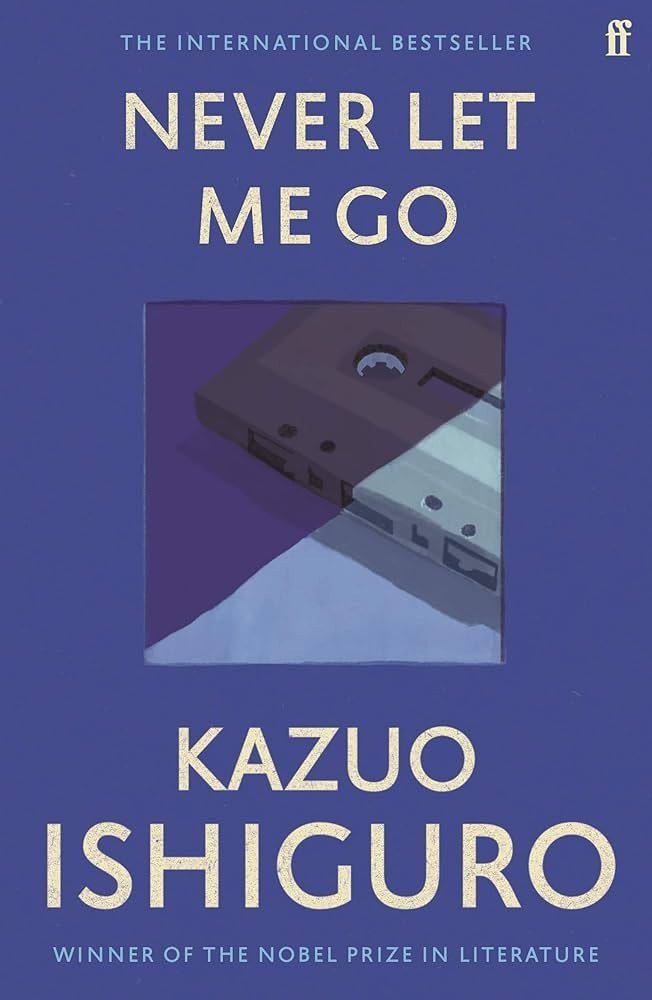
Never Let Me Go is remarkable partly because of how little it seems to be doing at first. Kathy remembers school friendships, minor arguments, exchanged possessions, teachers behaving strangely, and the shifting loyalties that define childhood. Nothing about her voice announces that she is living inside a nightmare. Kazuo Ishiguro lets the disturbing elements enter almost casually, hidden inside vocabulary Kathy considers ordinary. That restraint makes the novel far more unsettling than a louder dystopian story would have been.
Kathy’s narration is the novel’s great achievement. She does not explain her world as though she knows an outsider is listening; she simply remembers it. Her memories wander, double back, correct themselves, and attach enormous importance to moments that might initially appear trivial. The result feels less like a conventional plot being delivered and more like someone trying to preserve the pieces of a life before they disappear. Memory becomes both the structure of the novel and one of its deepest sources of consolation.
The relationship between Kathy, Ruth, and Tommy gives the speculative premise its emotional meaning. They experience jealousy, cruelty, affection, insecurity, sexual confusion, loyalty, and betrayal in ways that are painfully ordinary. Ishiguro does not make them extraordinary because of what has been done to them. He makes the larger injustice horrifying precisely because their emotional lives are so recognizably human. The question of whether they possess souls is therefore absurd long before the society around them is prepared to acknowledge it.
Ruth is particularly important because she prevents the novel from becoming sentimental. She can be manipulative, insecure, possessive, and hurtful, yet reducing her to the antagonist of a love triangle would miss what Ishiguro is doing. Ruth wants desperately to imagine a larger future for herself, and some of her worst behavior comes from knowing, at some level, how little control she actually has. Her attempts to perform confidence become another form of survival.
Tommy’s anger works differently. As a child, he is mocked for his emotional outbursts and lack of artistic ability; later, his frustration takes on a much darker significance. The society surrounding these children repeatedly teaches them to manage their feelings without ever giving them meaningful control over their lives. That contradiction reaches one of the novel’s most painful conclusions in Tommy: even when someone understands the injustice clearly, understanding does not necessarily create a way out.
One common criticism of Never Let Me Go is also one of the reasons it works so well: the characters do not revolt in the way dystopian heroes are expected to. They do not organize a revolution, destroy the institution, or dramatically escape. Readers sometimes find that passivity frustrating, but Ishiguro is pursuing something more uncomfortable. Most human beings live with limits they cannot defeat—most obviously death—and continue making friendships, falling in love, becoming jealous, wasting time, hoping for exceptions, and behaving as though life will somehow continue.
That is why the novel ultimately feels less like a warning about cloning than a book about mortality. The speculative system exaggerates a truth everyone already shares: our time is limited, the ending is known in advance, and we still spend enormous amounts of that time on small resentments and fragile hopes. Ishiguro himself has described the book as fundamentally concerned with the sadness of the human condition rather than as a prediction about technology. The science-fiction framework gives physical form to a problem the reader cannot escape by closing the book.
The novel’s emotional power also comes from what it refuses to dramatize. Ishiguro avoids graphic horror, elaborate scientific explanations, and lengthy political exposition. Institutions operate largely in the background, while the foreground remains filled with school memories, cassette tapes, fields, cottages, car journeys, and conversations between people who do not always understand what they are losing until it has nearly disappeared. The ordinary details become unbearable because the reader understands their scarcity.
What I Liked
Kathy’s voice is exceptional. Her calmness makes the novel more disturbing because horror appears through ordinary memories instead of dramatic revelation. I also liked the way Ishiguro refuses to reduce Ruth, Tommy, or Kathy to symbols of oppression; their jealousy, selfishness, tenderness, mistakes, and romantic confusion remain central. The speculative premise works because it never overwhelms the relationships.
What Could Be Better
The novel’s deliberate passivity can be frustrating, especially for readers accustomed to dystopian stories built around rebellion. Some of the later explanations about Hailsham and the wider system are also less powerful than the earlier ambiguity. Once certain mysteries are explained directly, the novel briefly loses some of the strange tension created by Kathy’s incomplete understanding. Its slow, repetitive memory structure will not work equally well for readers who want a fast-moving plot.
Context Behind the Book
Kazuo Ishiguro was born in Nagasaki in 1954 and moved to Britain when he was five. His novels include A Pale View of Hills, An Artist of the Floating World, The Remains of the Day, The Unconsoled, When We Were Orphans, The Buried Giant, and Klara and the Sun. The Remains of the Day won the Booker Prize in 1989, while Never Let Me Go was shortlisted in 2005. Ishiguro received the Nobel Prize in Literature in 2017. Across his work, he repeatedly returns to memory, self-deception, loss, identity, love, and the ways people construct meaning around lives they cannot completely control.