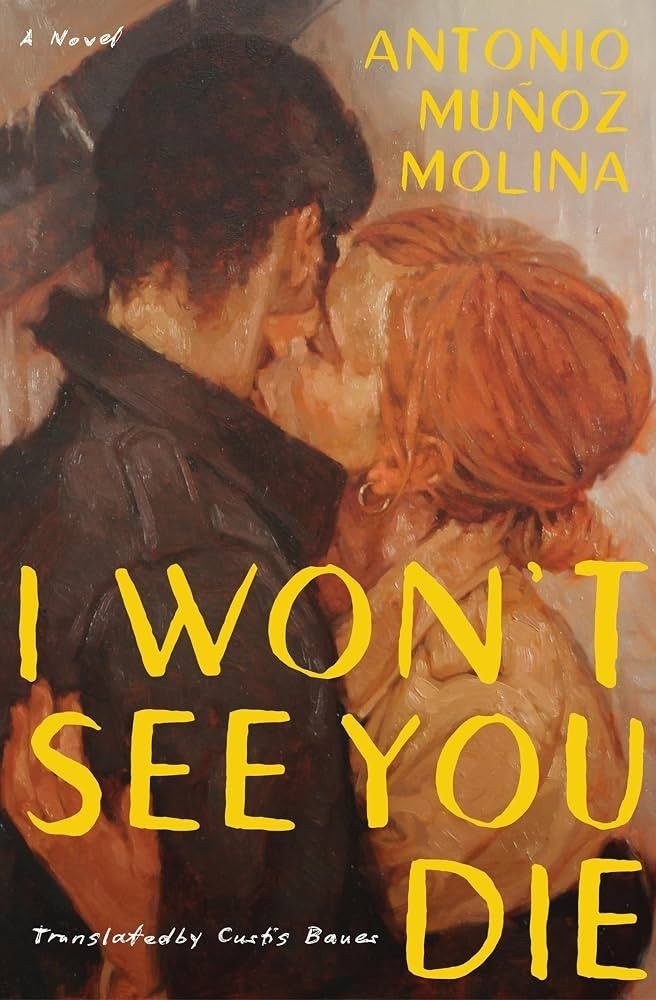
I Won’t See You Die is less interested in whether an old romance can be revived than in what happens when two people finally stand beside the lives they did not choose. Gabriel and Adriana’s reunion carries decades of imagination with it. Each has had enough time to transform the other into memory, regret, accusation, fantasy, and evidence of a lost self. Antonio Muñoz Molina understands that meeting again cannot simply recover the past because the people who once loved each other no longer exist in exactly the same form.
Gabriel is particularly compelling because his outwardly successful life cannot silence the feeling that it may have been shaped as much by obedience as by desire. His father’s history, family expectations, education, professional ambition, and eventual move to America all help carry him away from Adriana. Success therefore acquires an uncomfortable ambiguity. He has built the kind of life that should validate his choices, yet old age gives him enough distance to wonder how many of those choices were truly his.
That question becomes inseparable from Spain itself. Gabriel leaves a country still constrained by dictatorship, while Adriana remains within it. Their separation is deeply personal, but history is never merely background decoration. Political conditions affect education, mobility, family pressure, emotional possibility, and the kinds of futures people can imagine. Muñoz Molina is strongest when large historical forces enter the story indirectly through the shape of individual lives.
Memory complicates everything. Gabriel does not simply remember Adriana; he remembers the version of himself who existed when he loved her. Returning to Madrid therefore means confronting a double loss. He has lost the woman with whom he imagined a future, but he has also lost the young man who still believed that future was possible. The novel’s insight is that nostalgia for another person is often partly nostalgia for ourselves in their presence.
Midway through the novel, Julio Maiquez becomes an important lens through which Gabriel is seen more critically. The shift expands the story beyond one man’s private understanding of himself and introduces the possibility that Gabriel’s explanations may not be as reliable or complete as he believes. Publishers Weekly highlights Julio’s role in exposing the gap between Gabriel’s outward life and his suppressed impulses. This structural turn asks the reader to reconsider whether regret is always evidence that the abandoned path would truly have been better.
Curtis Bauer’s English translation has to carry a novel built heavily on reflection, memory, emotional digression, and changes in perspective. The result preserves the sense of a consciousness moving through time rather than simply recounting events in chronological order. That style is one of the book’s pleasures, but it also demands patience. Readers looking for a straightforward late-life romance may find the long sentences, historical detours, and psychological turns more challenging than expected.
The novel also resists turning Adriana into a simple symbol of the life Gabriel missed. Their eventual encounter includes desire and tenderness, but it also carries reproach and the uncomfortable reality that both people continued living after their separation. This is important because the easiest version of the story would treat first love as automatically more authentic than everything that came afterward. Muñoz Molina is more skeptical. A life can contain genuine love, compromise, betrayal, duty, and regret without any one of those experiences completely invalidating the others.