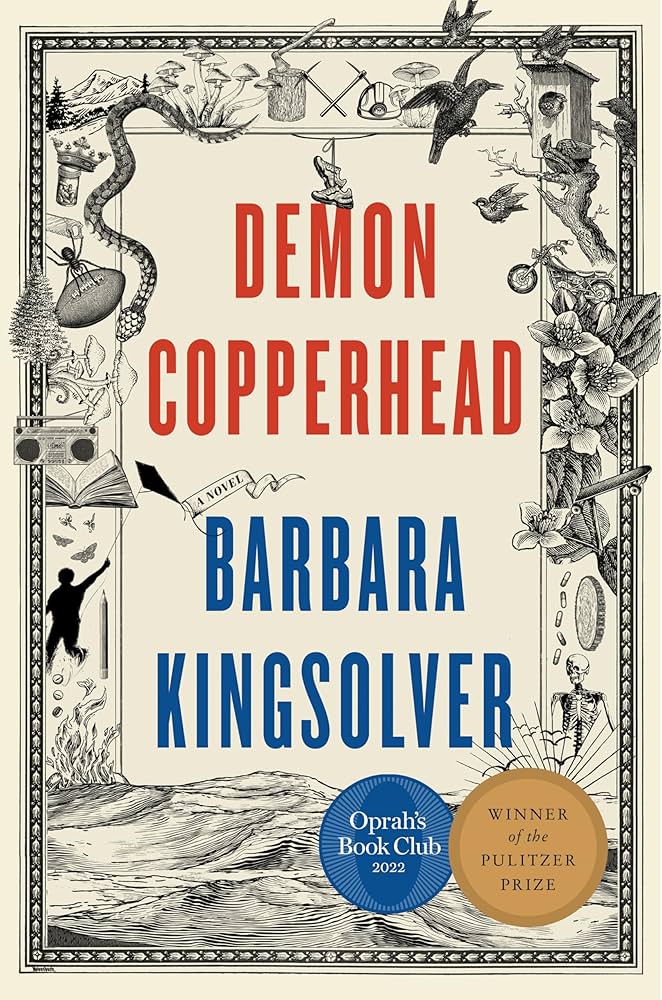
I want to say upfront that i went into this knowing it was inspired by David Copperfield and i was a little worried that knowledge would distance me from the story, make me read it as an exercise rather than feel it as a novel. That worry lasted about ten pages. After that i forgot entirely that i was reading anything other than Demon's own voice telling me his own life.
Demon is born in a trailer in Lee County, Virginia to a teenage mother who is still struggling with her own addiction and he tells you straight away, with the kind of dark humor that runs through the whole book, that he was already considered a lost cause before he had done anything to earn that label. What follows is his childhood and adolescence moving through the failures of the build care system, through hard labor on tobacco farms, through a genuine talent for football that almost gives him a way out, and eventually into the opioid addiction that swallowed so much of his community whole.
Kingsolver is working directly from David Copperfield here and if you know that novel you will recognize the bones of it everywhere, the absent father, the difficult stepfather figure, the kind woman who takes him in, the friend who seems golden and turns out to be something else. What is remarkable is how completely she makes this structure her own. This never reads like an academic exercise in adaptation. It reads like Demon's actual life because Kingsolver has done the harder work of finding a contemporary equivalent for every Dickensian beat that feels earned rather than mechanical.
What the book is really angry about, underneath the story of one boy, is how an entire region of America got treated as disposable. Kingsolver writes about the opioid crisis not as a sudden epidemic that arrived from nowhere but as the direct result of decades of economic abandonment, a medical system that profited from prescribing addictive pain medication to people doing genuinely dangerous physical labor, and a culture that looked at the resulting addiction and called it a personal failing rather than what it actually was. This anger never overwhelms the storytelling. It runs underneath it the whole time, giving weight to every loss Demon experiences.
The build care section in the middle of the book is the hardest stretch to get through, not because it is badly written but because Kingsolver does not soften what happens to kids who fall through the cracks of an overwhelmed system. There were chapters where i needed to put the book down for a day before continuing because the accumulation of hardship felt almost too much. I think this is intentional. I think Kingsolver wants you to feel the exhaustion of it the way Demon feels it. But i would be lying if i said it was always comfortable to read.
June, a nurse who becomes one of the steadiest presences in Demon's life, and Coach Winfield, who sees something in Demon that the rest of the world has stopped looking for, are two of the most genuinely good characters in contemporary fiction i have encountered recently. Kingsolver writes goodness without making it boring or simple, which is harder than writing villainy well.
The ending earns every bit of hope it allows itself, which is not very much, but what little it gives feels completely real rather than imposed. I will not say what happens. I will say that i finished the book and sat with it for a long time before i did anything else, which is the highest compliment i can give any novel.
The voice is everything in this book. Demon narrates his own story and he does it with a mixture of bitter humor and genuine tenderness that makes him one of the most alive narrators i have read in years. He notices everything.