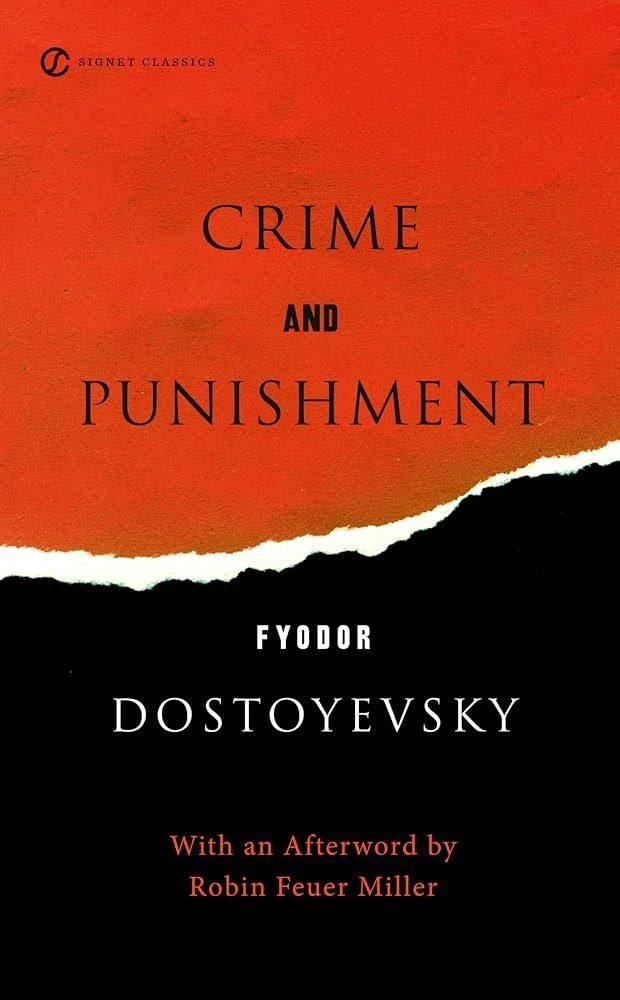
I read Crime and Punishment quickly at first, then slowed down when guilt became harder to brush aside. Impoverished student Raskolnikov commits murder to test a theory about exceptional people, then discovers ideas cannot protect him from guilt. I did not need another twist before the feverish psychological pressure entered the setup. I needed the people affected by guilt around the feverish psychological pressure to feel specific, and mostly they did.
The people gave guilt its real pressure through the feverish psychological pressure. Raskolnikov is exhausting and compelling because his intelligence builds arguments that his body and conscience refuse to accept. The person on the page is allowed to be inconsistent about guilt, which made the choices easier to trust. I was most attentive during the feverish psychological pressure, cramped city, and verbal duels with investigator Porfiry. The attention paid to the feverish psychological pressure gives the larger question of guilt a human scale.
For me, the real argument concerns guilt and pride. The plot matters because it forces guilt and pride into practical choices, where a clean belief becomes harder to maintain.
I did lose confidence when the melodrama and coincidences can be heavy, while several secondary women are treated symbolically. A little more patience would have made the material around guilt easier to believe.
The pace is uneven, but the shifts usually follow a change in how the characters understand guilt through the feverish psychological pressure.
The experience of Crime and Punishment was uneven, but never empty. I am still caught on the question of guilt and who gets to define it.
What I Liked
What worked for me was the feverish psychological pressure, cramped city, and verbal duels with investigator Porfiry. The book also benefits from this character choice: Raskolnikov is exhausting and compelling because his intelligence builds arguments that his body and conscience refuse to accept. I remembered the scenes around the feverish psychological pressure more clearly than the larger speeches.
What Could Be Better
The weaker part for me was that the melodrama and coincidences can be heavy, while several secondary women are treated symbolically. It did not erase what worked in Crime and Punishment, though it made the structure feel more visible than I wanted.
Context Behind the Book
Dostoevsky's imprisonment and Siberian exile shaped his lifelong interest in guilt, freedom, faith, radical ideas, and unstable moral argument.