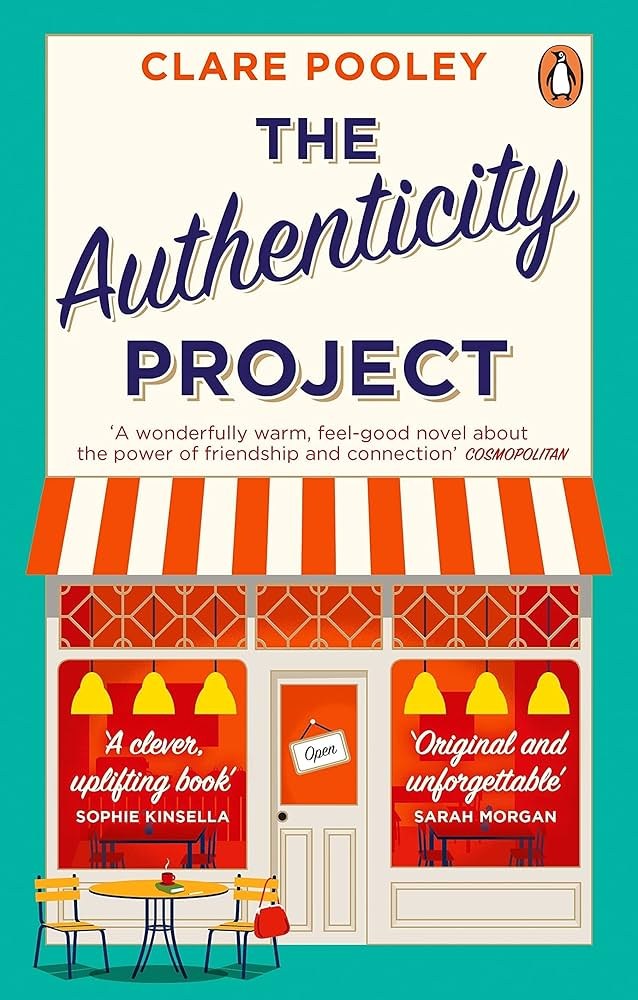
The Authenticity Project book cover by Clare Pooley
⏱️
Estimated Read Time
8-10 hours

The Authenticity Project Review

✍️ Book by Clare Pooley
Editorial Rating
★★★★☆ 4.2
Epiloguely review by Shadab Alam
Reader Rating
☆☆☆☆☆ 0.0
No reader ratings yet
Rate This Book
A written review is optional
Published2020-02-04
SeriesStandalone
GenreContemporary Fiction, Community Fiction
LanguageEnglish
PublisherPamela Dorman Books / Viking
ISBN-101984878611
ISBN-139781984878618

📝Epiloguely Editorial Review

Written and reviewed by .

The Authenticity Project works best when it stops feeling like a clever premise and starts feeling like a story about people who have become very good at hiding how lonely they are. The idea is simple: a lonely artist leaves a notebook in a café and writes an honest account of his life, inviting whoever finds it to do the same before passing it on. One confession leads to another, and gradually a group of strangers begins to form around truths they might never have admitted face to face.

What interested me most was not the notebook itself but what happens once those written confessions begin affecting real relationships. Writing honestly on a page is one thing. Living with that honesty once other people know you is much harder. The novel understands that difference, and that is where the premise becomes more than a sentimental exercise.

The café gives the story a useful center. People come and go, conversations overlap, and characters who would probably never have chosen one another slowly become part of the same social circle. I liked the way that community develops almost accidentally. Nobody sets out to build a found family. People simply keep returning, getting involved in one another’s problems, offering help, creating new complications, and becoming harder to avoid.

That messiness matters.

The characters are not only improved by the community around them. They are also inconvenienced by it. They have to explain themselves. They get judged. They misunderstand one another. Sometimes another person’s honesty creates a problem rather than solving one.

That made the theme of honesty more interesting to me.

The book could easily have argued that telling the truth automatically makes life better. Instead, some confessions expose the distance between how a person sees themselves and how they actually behave. A character can write something deeply sincere and still be selfish five minutes later.

That contradiction is important because it keeps the idea of authenticity from becoming too clean.

The multi-generational friendships were another part I enjoyed. The people connected by the notebook are at very different stages of life, which means loneliness does not look the same for all of them. For one person it comes from age and isolation. For another it comes from maintaining an image. Someone else may be surrounded by people and still feel that nobody really knows them.

That variety gives the novel warmth without making loneliness feel like one single problem with one single solution.

I also appreciated how much of the emotional work happens in ordinary spaces. The café, the neighborhood, meals, small favors, and casual conversations gradually become more important than the original confession that brought everyone together. Once the characters begin choosing to spend time with one another, the notebook itself almost becomes secondary.

I think that is a strength.

The premise brings them together, but the relationships have to keep them there.

The novel is especially good when it allows someone to reveal themselves indirectly. A character may say one thing in the notebook and behave very differently in person. Another may claim to be fine while obviously avoiding something. Those gaps are more revealing than the larger speeches about honesty.

I sometimes wished the book trusted those gaps even more.

My biggest reservation is that some of the character arcs become very tidy. People who begin with obvious flaws often move toward exactly the kind of emotional resolution you can see waiting for them. That does not make the story unpleasant, but it can make the structure feel visible.

At times I could sense the novel arranging people into place.

The premise itself also has that slightly engineered quality. A notebook happens to move through exactly the right group of strangers, and the café becomes the perfect meeting point for their lives to overlap. I was willing to accept that because the book is aiming for warmth rather than realism, but there were moments when I wanted more friction and fewer convenient connections.

Some of the characters are broadly drawn for the same reason. Their personalities are immediately readable, which helps an ensemble novel move quickly, but it can also make them feel like recognizable types before they begin to feel like specific people.

The stronger characters eventually grow beyond that.

The weaker ones never completely do.

I think the novel is more convincing when it deals with loneliness than when it tries to make a larger statement about honesty. Loneliness appears through behavior: someone lingering in the café longer than necessary, someone becoming too involved in another person’s life, someone creating an impressive public version of themselves because the private version feels inadequate.

Those moments feel observed rather than explained.

The theme of honesty occasionally becomes more direct. Characters talk about being authentic, about presenting false versions of themselves, about what happens when people finally tell the truth. The point is clear enough that I did not always need it stated again.

One more uncomfortable scene in which honesty genuinely damaged a relationship would have made the theme stronger for me than another reassuring resolution.

Still, I liked the way the novel treats community as something imperfect.

The people brought together by the notebook do not become close because they are naturally compatible. They become close because they keep showing up. They listen badly, help awkwardly, interfere too much, and sometimes offer exactly what another person needs without realizing it.

That feels closer to real friendship than the cleaner parts of the plot.

By the end, the café meant more to me than the notebook. The notebook begins the story by asking people to tell the truth about themselves, but the café becomes the place where those truths have consequences. People have to sit across from one another after the confessions. They have to decide whether knowing more about someone actually makes them kinder.

That is where The Authenticity Project found its emotional weight for me.

It is not a perfectly subtle novel, and several transformations are more neatly arranged than I would have liked. But its interest in ordinary loneliness feels genuine. The book understands that people can be surrounded by work, family, social media, customers, or friends and still feel as though nobody has met the person underneath all of that.

The notebook asks the characters to admit that.

The café makes them live with it.

Book Summary

A lonely artist leaves a notebook inviting strangers to write one honest truth, gradually connecting people who have been performing better lives than they have. The emotional pull comes from the fact that The ensemble works because each person is both helped and inconvenienced by the community forming around the notebook. The novel deals with loneliness, honesty, addiction, social media, friendship, performance, trust, and curated identity without offering a completely clean answer.

What I Liked

I was most engaged by the café setting, chain of confessions, multi-generational friendship, and hopeful attention to ordinary loneliness. The ensemble works because each person is both helped and inconvenienced by the community forming around the notebook. The combination gave The Authenticity Project warmth, tension, or unease exactly where it needed it.

What Could Be Better

I had trouble with the fact that some transformations are tidy, the premise feels engineered, and characters are broadly drawn. A little more restraint or development around loneliness in The Authenticity Project would have made the emotional result more convincing.

Context Behind the Book

Clare Pooley is a British novelist and memoirist whose work often explores honesty, addiction, social connection, and unexpected communities.

Reader Reviews

0 published written reviews · Reader star ratings remain separate from the editorial rating.

No reader reviews yet Be the first reader to share a thoughtful review of at least 100 words. A quick star rating can still be submitted separately above.

📊Reader Rating Breakdown

0.0
★★★★★
No reader ratings yet

No reader ratings yet. Be the first reader to rate this book using the separate quick-rating stars above.

🎭Vibe Check

What's the vibe of this book?
💬 Open Reader Comments & Discussion

Use the separate comment-style discussion room for spoilers, endings, characters, theories, questions, and replies. Formal reader reviews stay on this page.