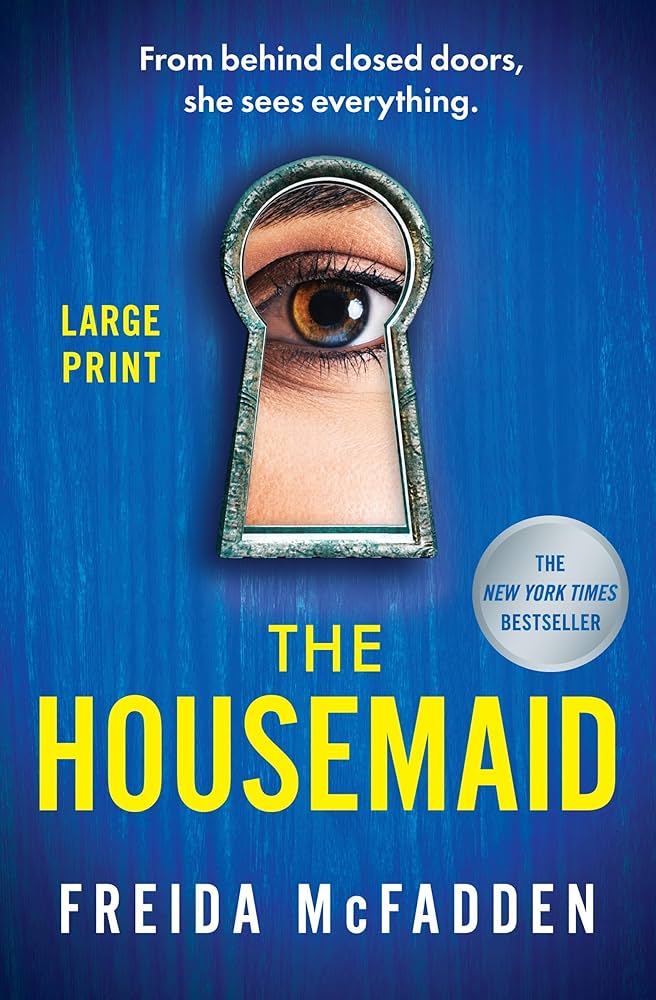
The Housemaid is not a subtle book and i do not think subtlety is what it is trying to offer. It wants you to sit down for one chapter, become suspicious of everyone, and discover three hours later that you have somehow read most of it. On that level it works extremely well.
Millie is living in her car when she interviews for a job with the wealthy Winchester family. She has a criminal record, almost no money, and very few choices, so the live-in position feels like a rescue even though the house begins sending warning signals immediately. Nina Winchester is unpredictable and humiliating. Her husband Andrew is calm, attractive, and apparently embarrassed by his wife's behavior. Their daughter Cecelia is openly hostile. Millie's bedroom is a tiny attic room with a door that can lock from the outside.
McFadden builds the first half around the pleasure of recognizing danger while the narrator keeps finding reasons to stay. Millie needs the job. The salary is good. Andrew is kind to her. Nina behaves badly enough that Millie's sympathy shifts toward everyone who has to live with her. None of these reasons are completely convincing, but they are convincing enough when combined with Millie's desperation.
The short chapters do a lot of work. Almost every one ends with a new insult, discovery, threat, or question. The prose is plain and the scenes move quickly because McFadden rarely spends time on anything that does not create suspicion. I finished the book faster than i expected, not because the writing was beautiful but because the structure is very efficient at making stopping feel inconvenient.
Millie is a useful narrator because she is hiding information from the reader as well as from the family. Her past is revealed gradually, and the fact that she has already done something serious makes her both vulnerable and potentially dangerous. I liked that she is not written as a completely innocent young woman wandering into a bad house. She has anger, survival instincts, and the capacity to make a terrible choice when she believes it is necessary.
The problem with discussing the second half is that almost every meaningful point risks revealing the mechanism. There is a major shift in perspective and the novel asks you to reinterpret what looked obvious in the first half. Some of the reversal is genuinely satisfying because small details return with a different meaning. Some of it depends on characters performing their roles with a precision that feels designed for the reader rather than natural inside the story.
Nina is the character who changes most as the novel reveals more information. Early on she can feel so exaggerated that i wondered whether the book was intentionally making her impossible to believe. The answer is connected to the larger twist, and while that explanation helped, it did not completely erase the artificiality. Andrew is effective as a thriller character but less convincing as a fully textured person. He is written to control the emotional temperature of a scene, and you can sometimes see the plot using him.
The domestic setting is handled well. The Winchester house is large, expensive, and constantly claustrophobic. Millie has access to every private room because she cleans them, yet she has no real privacy of her own. The attic bedroom turns the class arrangement into a physical fact: she is inside the family home but kept above it, useful and disposable.
The novel also understands the fantasy hidden inside many domestic thrillers. People who are underestimated because of class, gender, or their past are given a chance to see what respectable society hides. Millie notices the mess behind the polished rooms because cleaning is her job. McFadden uses that position directly rather than treating the housemaid title as decoration.