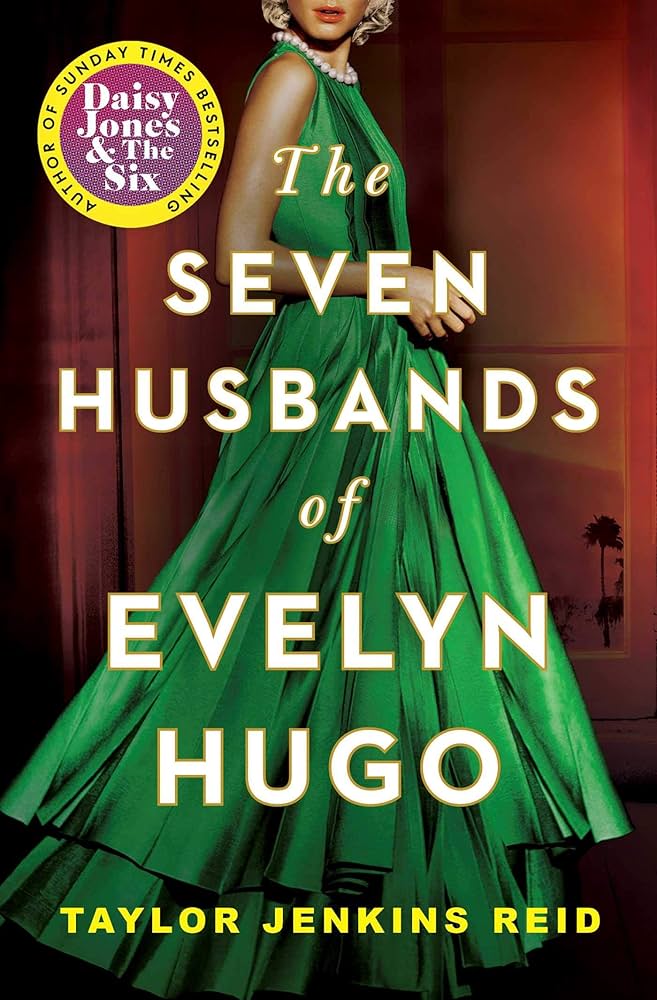
I had seen this cover everywhere for so long that i started to assume i already knew what kind of book it was. Old Hollywood glamour, seven marriages, a famous actress with secrets. I expected something entertaining and slightly dramatic, the kind of book that moves quickly and gives you a few good twists. It does all of that, but the reason it stayed with me had much less to do with the husbands than i expected.
Evelyn Hugo is nearly eighty when she chooses Monique Grant, an unknown magazine writer, to tell her life story. Nobody understands why Evelyn wants Monique specifically, including Monique herself. Evelyn has spent decades controlling what the public knows about her and now she says she is finally ready to tell the truth. The structure moves between the present-day conversations and Evelyn's rise from a poor Cuban American teenager in Hell's Kitchen to one of the most famous actresses in the world.
The seven husbands give the book its chapters and its marketing hook, but they are really a way of measuring the different versions of Evelyn. Each marriage belongs to a period when she needed something: escape, safety, publicity, protection, companionship, or a way to hide what the world would not allow her to say openly. Reid understands that a person can make a selfish decision for a completely understandable reason, and Evelyn is allowed to be ambitious, calculating, loving, cruel, generous, and frightened without the book forcing those qualities into a clean moral lesson.
The relationship at the center of the novel is not one i want to explain too fully because discovering its shape is part of the reading experience. What i can say is that Reid is very good at showing the difference between the person someone loves and the life they are willing to build around that love. Evelyn knows how to survive in public, but survival requires compromises that become habits, and those habits hurt the people closest to her. The book is strongest whenever it refuses to pretend that love automatically makes people brave.
I also liked the way the novel handles fame. Evelyn is not presented as a helpless victim of Hollywood, but the industry is still brutal toward her. Men are allowed to age, desire, fail, and start again. Women are treated as products with an expiry date. Evelyn learns to use the same machinery that uses her, and the result is empowering in one scene and deeply sad in the next. Her Cuban identity is something the studio tries to erase, while her sexuality is something the entire culture makes dangerous. Reid keeps both pressures present without turning Evelyn into a symbol instead of a person.
The writing is very accessible. Reid does not slow down for elaborate description and the dialogue often has the clean rhythm of a television drama. That makes the book extremely readable, but it also means some emotional moments are stated more directly than i needed. A few of the husbands feel fully alive while others remain closer to functions in Evelyn's larger story. I understood why each marriage mattered, but i did not always believe in the man beyond that purpose.
The final reveal connects Evelyn and Monique in a way that is effective, though i guessed part of it before the book confirmed it. What mattered more to me was the moral problem it creates. Evelyn wants to own the truth at the end of her life, but owning a truth does not erase the damage caused by hiding it. The book lets Monique be angry and compassionate at the same time, which is exactly the response Evelyn deserves.
Monique's present-day storyline is quieter. She is dealing with the end of her marriage and trying to understand why Evelyn has selected her.