Dusk worries that his people will become dependent on civilizations whose gifts always come with conditions, while Starling and the Dynamic crew are already learning what financial and political dependence feels like on a much larger scale. Their alliance therefore grows from necessity before it grows from trust. That makes the relationship more convincing than if they had immediately recognized each other as natural partners.
The emberdark itself gives Sanderson a setting where fantasy and science fiction can exist without one cancelling out the other. Spaceships travel through a universe where myths can still be true, dragons can work alongside crews worried about money, and ancient magical events can have consequences that technologically advanced societies do not fully understand. Sanderson has been moving the Cosmere in this direction for years, but Isles of the Emberdark makes that transition especially visible. The interesting part is that advanced technology does not make the old magic feel obsolete. If anything, the contrast makes both sides stranger because the characters keep discovering that technical knowledge and historical understanding are not the same thing.
That distinction becomes important whenever Dusk encounters people who assume technological advancement automatically proves cultural superiority. His own society may appear primitive beside interstellar civilizations, yet he possesses knowledge that outsiders repeatedly underestimate because it has been preserved through experience and oral tradition rather than through institutions they recognize. The book does not pretend every old belief is automatically correct, but it takes seriously the possibility that knowledge can survive in forms powerful societies dismiss too quickly. FanFiAddict highlighted this aspect of the novel, particularly Dusk's relationship with oral storytelling and the tension between inherited knowledge and supposedly superior outside systems.
I also liked that modernization is not treated as a simple villain. It would have been easy to romanticize Dusk's traditional way of life and make every new machine or outside influence a symbol of corruption, but Patji is genuinely dangerous and Dusk knows his people cannot freeze themselves in time. Some new knowledge can save lives, strengthen communities, and help them resist exploitation. The problem begins when technological advancement is controlled by people whose interests are not the same as the people receiving it. That makes the book's argument more useful because Dusk is not fighting to preserve every old practice; he is fighting for his people to retain enough independence to decide what changes they are willing to make.
The novel's wider Cosmere material is both exciting and potentially intimidating. Readers who already know worlds such as Scadrial and Roshar will recognize the significance of certain factions, technologies, and assumptions about how the universe has changed. Those connections give longtime readers a glimpse of where Sanderson's larger project is heading, especially now that different planetary powers are increasingly capable of meeting one another directly. At the same time, the book takes place far enough into the Cosmere's future that even familiar civilizations have changed considerably. That distance actually helps the standalone story because Dusk is discovering much of this larger political reality alongside readers who may not know every reference.
Still, calling the book a standalone requires a small qualification. You can understand Dusk's problem, Starling's situation, the adventure through the emberdark, and the central conflict without studying Cosmere lore first. Sanderson also incorporates material from Sixth of the Dusk so the earlier novella is not a strict prerequisite. The difference is that experienced Cosmere readers will recognize implications that newcomers may simply accept as background worldbuilding. That does not break the novel, but it means two readers can finish the same story with very different levels of excitement about what certain revelations might mean for future books.
The pacing is one of the book's clearest strengths. Sanderson spends enough time establishing Patji, Dusk's fears, Starling's crew, and the political situation before allowing the story to expand into larger confrontations. Once the separate threads begin meeting, the book moves quickly through negotiations, discoveries, dangerous environments, and shifting alliances without losing sight of why Dusk started the journey. FanFiAddict particularly praised the way the pace builds toward the kind of rapid final sequence Sanderson readers often call a "Sanderlanche." The ending works because the acceleration feels like the release of pressure that has been building through the earlier political and cultural conflicts rather than action appearing simply because the book needs a climax.
My larger reservation is that the sheer amount of interesting Cosmere material can sometimes compete with the more intimate story. A strange civilization, new technology, unusual magical interaction, or familiar Cosmere connection can be exciting enough that it temporarily draws attention away from Dusk's quieter fear of losing his people. Sanderson usually brings the narrative back to that emotional center, but readers deeply invested in Cosmere lore may find themselves treating some chapters as evidence for larger theories instead of as parts of Dusk and Starling's story. That is partly unavoidable in a shared universe this large, especially when a novel is deliberately showing us a future stage of that universe.
There is also a difference in how strongly the two main perspectives land. Dusk arrives with the weight of Patji, the earlier novella, his people's traditions, and a very specific understanding of survival, which gives him an immediate gravity. Starling is entertaining and her situation adds range to the book, but parts of her story can initially feel more familiar: an indebted crew, a risky discovery, and one dangerous job that might change everything. She becomes more compelling as the novel develops and as her personal limitations become clearer, yet Dusk remains the character who gives the story its most distinctive identity. When the novel returns to his tension between survival and cultural compromise, it feels like it has returned to its deepest question.
What stayed with me most was the book's refusal to assume that being more advanced means having better answers. Dusk comes from a society that other powers can easily underestimate, yet his understanding of Patji, his caution, and his willingness to treat old stories as information repeatedly matter. The technologically advanced characters have access to extraordinary tools, but those tools cannot automatically tell them which compromises are worth making or what should be preserved. Sanderson uses the enormous scale of a space-fantasy universe to ask a surprisingly local question: when change becomes unavoidable, how do people decide which parts of themselves they can afford to change and which parts they cannot afford to lose?
That theme makes Isles of the Emberdark more satisfying than a simple preview of the Cosmere's space age. The spaceships, dragons, magical birds, rival powers, portals, and ancient mysteries are entertaining, but the book works because all of them apply pressure to characters who are trying to remain themselves while circumstances demand adaptation. Dusk and Starling are both fighting for independence, though neither can achieve it by refusing every alliance or outside influence. Their story recognizes that freedom is rarely complete and that survival often requires compromise, but it also refuses to treat every compromise as harmless.
Book Summary
Sixth of the Dusk has spent his life surviving on Patji, a deadly island where traditional trappers bond with supernatural birds known as Aviar. His people are now facing a threat that hunting skills and old knowledge may not be enough to stop: technologically superior visitors known as the Ones Above are pushing their world toward rapid modernization while quietly positioning themselves to exploit it. Dusk fears that refusing change could leave his people defenseless, but accepting everything offered by outsiders may destroy the culture he is trying to save.
Far beyond Patji, Starling is a young dragon trapped in human form and serving aboard the starship Dynamic. She and her crew are drowning in debt when an ancient map offers a possible route through the mysterious emberdark and into a discovery valuable enough to change their situation. When Starling's journey crosses Dusk's, the two characters find themselves dealing with rival powers, dangerous bargains, old legends, and a problem connected to a dead god. Sanderson uses their adventure to push the Cosmere into its far-future space age while still keeping the story rooted in questions about identity, independence, tradition, and what progress actually costs.
What I Liked
The strongest part of the book for me is Dusk's conflict between modernization and cultural survival. Sanderson does not reduce the issue to technology being bad or tradition being automatically wise; Dusk knows that his people need new tools and knowledge, but he also understands that dependence can become another form of conquest. The Aviar strengthen that theme because outsiders see something valuable that Dusk's culture understands in a much deeper way than simple scientific classification can capture. I also liked the way the far-future science-fiction elements sit beside older forms of magic without making either side feel misplaced.
The partnership between Dusk and Starling also gives the story a useful contrast. They come from radically different backgrounds, yet both are dealing with powers capable of limiting their freedom. Their alliance develops through practical need and gradually becomes more meaningful, which keeps the adventure grounded while the setting expands into interplanetary politics. The later pacing is especially strong, and the final stretch delivers the rapid escalation Sanderson is known for without losing the central questions about independence and identity.
What Could Be Better
The larger Cosmere sometimes threatens to become more interesting than the novel directly in front of us. References to future factions, advanced technology, and developments elsewhere in the universe can invite longtime fans to stop thinking about Dusk and start thinking about what everything means for the next ten Cosmere books. The story usually pulls itself back, but a little more restraint in those moments would have kept the emotional focus even tighter.
Starling's early material also feels somewhat more familiar than Dusk's. A desperate crew in debt discovering a potentially valuable route is a strong adventure setup, but Dusk's cultural conflict is immediately more unusual and emotionally specific. Starling develops considerably once her relationship with Dusk and her own limitations become clearer, yet it took longer for her sections to carry the same weight. New Cosmere readers may also occasionally feel that they are missing background information even though the primary plot remains understandable.
Context Behind the Book
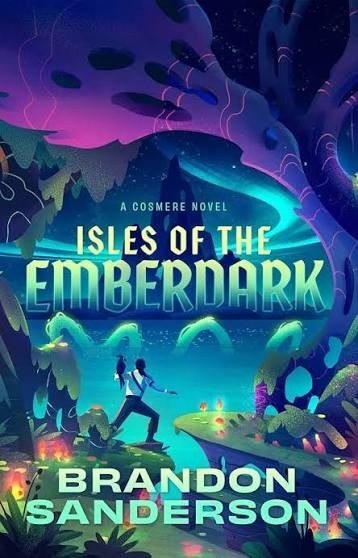
Brandon Sanderson is an American fantasy and science-fiction author best known for creating the interconnected Cosmere universe, which includes the Mistborn series, The Stormlight Archive, Elantris, Warbreaker, Tress of the Emerald Sea, and several other novels and novellas. He also completed Robert Jordan's The Wheel of Time series after Jordan's death and won the Hugo Award for his novella The Emperor's Soul. Sanderson is especially known for detailed magic systems, large-scale worldbuilding, interconnected series, and tightly structured climactic sequences. Isles of the Emberdark expands Sanderson's earlier novella Sixth of the Dusk and pushes the Cosmere much further into its spacefaring future. The novel remains centered on Dusk and the world of First of the Sun, but it also provides a clearer look at how different Cosmere civilizations may interact once travel between worlds becomes increasingly common. The book is illustrated by Esther Hiʻilani Candari.