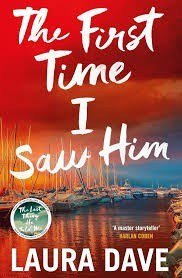
The First Time I Saw Him book cover by Laura Dave
⏱️
Estimated Read Time
5–6 hours

The First Time I Saw Him — Book Review

✍️ Book by Laura Dave
Editorial Rating
★★★★☆ 4.4
Epiloguely review by Shadab Alam
Reader Rating
☆☆☆☆☆ 0.0
No reader ratings yet
Rate This Book
A written review is optional
Published2026-01-06
SeriesHannah Hall #2
GenreThriller,Suspense,Mystery
LanguageEnglish
PublisherScribner
ISBN-101668002965
ISBN-139781668002964

📝Epiloguely Editorial Review

Written and reviewed by .

The First Time I Saw Him has a difficult job because the first book ended on exactly the kind of uncertainty that made readers keep thinking about it. Owen was gone, Hannah and Bailey were safe for the moment, and the possibility of seeing him again existed more as hope than as a plan. Laura Dave could easily have weakened that ending by explaining too much. Instead, the sequel begins by turning that brief possibility into a new crisis.

Five years have passed, and Hannah is no longer the woman who was suddenly left behind with a teenage stepdaughter and a collection of unanswered questions. She and Bailey have built a life together, and the most important change is not where they live but how completely their relationship has shifted. Bailey no longer feels like the difficult teenager Hannah is responsible for because of Owen. She is family in her own right, and Hannah's instinct to protect her no longer depends on the man who originally connected them.

That relationship gives the sequel its strongest emotional foundation. The thriller plot moves quickly, but the book would feel much thinner if Hannah and Bailey were still arguing over whether they belonged to each other. Instead, the years between the two novels have allowed their bond to become something more settled. That matters because once the danger returns, Hannah is not simply protecting Owen's daughter. She is protecting her daughter.

Owen's reappearance interrupts that stability almost immediately. He does not return with a long explanation or a sentimental reunion. His presence tells Hannah that something has gone wrong, and the warning he leaves behind forces her and Bailey back into the kind of survival mode they hoped they had left behind. Dave keeps that opening tight, and the tension works because Hannah understands the seriousness of the situation before the reader knows exactly what has happened.

The mystery is no longer simply about why Owen disappeared. Readers of The Last Thing He Told Me already know much of that history. The question now is whether the elaborate arrangements created to protect Hannah and Bailey can survive without Nicholas Bell, Bailey's grandfather and the former lawyer connected to the criminal organization Owen betrayed.

Nicholas is one of the more interesting changes in the sequel. In the first book, he represented danger because Hannah had no reason to trust him. Here, the years have complicated that judgment. He has become part of Hannah and Bailey's life, and his relationship with them gives the story a useful reminder that people do not remain fixed in the role they occupied when we first met them.

The book becomes more ambitious once it starts moving between Hannah's present, Owen's missing years, and Nicholas's earlier efforts to protect the family. Those shifts could have made the plot unnecessarily complicated, but for the most part they help explain why the danger has returned without stopping the forward movement of the chase. Publishers Weekly specifically praised Dave's handling of the multiple perspectives and timelines, and that seems fair because the information usually arrives when it can change how we understand the present rather than simply filling in background.

Owen benefits from those sections because the first book necessarily kept him at a distance. Much of what we knew about him came through what he had hidden or through Hannah's memories of their marriage.

Here, the story has more room to consider what disappearing actually cost him. Leaving may have been intended as protection, but it also meant losing years with the people he was trying to save.

That gives the idea of a second chance more weight. Hannah does not only have to decide whether she still loves Owen. She has to decide what love means after five years of absence, secrecy, and choices she was never allowed to participate in. A reunion cannot simply restore the marriage to what it was because the people involved are no longer the same.

I liked that the novel does not ignore this problem in favor of pure suspense. The chase matters, but the emotional question underneath it is whether Hannah can trust a future built with someone whose most important decisions were made without her. Owen had reasons for what he did, and some of those reasons were convincing, but good intentions do not automatically erase the damage caused by secrecy.

Bailey has an even more complicated claim on him. Owen is her father, and his disappearance shaped much of her young adulthood. Any possibility of getting him back therefore carries both hope and anger. The book is strongest when it allows those feelings to coexist rather than treating reunion as an uncomplicated reward.

The suspense itself is more openly cinematic than in the first novel. Hannah and Bailey move through contingency plans, hidden resources, coded information, safe locations, and eventually international travel as they try to stay ahead of people connected to Nicholas's former clients. At times, the preparation they have made over the previous five years makes them seem surprisingly capable, but that competence also feels earned by what happened before.

They have lived for years knowing that safety might disappear.

Of course they planned.

What I appreciated most was that the novel does not make Hannah suddenly behave like a professional operative. She remains someone who has learned because she had to. The distinction is small but important. Her strength comes from preparation and determination rather than from the story transforming her into someone completely different from the woman readers already know.

The pacing is fast, particularly in the first half, and Dave rarely leaves the characters in one place long enough for the threat to feel distant. The California sections have a different energy from the later movement toward Europe, but the story keeps returning to the same central pressure: every decision Hannah makes is judged by whether it improves Bailey's chances of surviving.

That urgency can also become one of the book's limitations. Because so much is happening, some emotional moments pass more quickly than I wanted. The story has several relationships that deserve space—Hannah and Owen, Bailey and Owen, Bailey and Nicholas, Nicholas and the people he once represented—but the thriller structure keeps pushing everyone forward.

There are also moments when the machinery behind the protection plans becomes a little too convenient. Hidden resources, prepared escape routes, coded clues, and carefully arranged contingencies are entertaining, but the more perfectly they line up, the more visible the plotting becomes. I could accept most of it because the characters have had years to prepare, though a few developments still feel designed primarily to keep the chase moving.

The criminal organization is another area where the book is less convincing than its family material. The emotional relationships are specific, but the syndicate sometimes functions as a more general source of danger. The threat is effective because we know what it could do to the family, yet I was more interested in Nicholas's personal relationships within that world than in the organization itself.

That is probably why the flashbacks involving Nicholas and Owen work better than a straightforward crime plot would have. The danger becomes personal once it is tied to loyalty, betrayal, old friendships, and people who believe they have been wronged. Dave repeatedly returns to the idea that family loyalty can produce both protection and violence, depending on who is defining what loyalty requires.

The title becomes more meaningful in that context. Seeing someone again after years apart sounds romantic until you consider everything that has happened during the absence. Hannah has imagined Owen's return, but the reality arrives with danger attached. The person standing in front of her is both the husband she remembers and someone who has lived an entire hidden life since she last knew him.

That tension gives the romance more weight than a simple reunion story would have had. Second chances are attractive because they suggest that something lost can be recovered, but the novel understands that recovery is not the same as restoration. Hannah and Owen cannot go back to the marriage they had. If they are going to have anything, it has to be built with the knowledge of what happened after it broke.

Forgiveness is therefore one of the book's more important themes, but Dave does not treat it as forgetting. Hannah can understand why Owen left and still resent that he left. Bailey can love her father and still carry the consequences of his absence. Nicholas can become someone they trust without his earlier choices disappearing.

That is where the novel feels more mature than a thriller built only around reunion and escape. People are allowed to remain complicated even when the plot needs them to work together.

I also liked the way Hannah and Bailey's relationship quietly answers one of the biggest emotional questions from the first novel. Owen's disappearance originally forced them together, but five years later their bond no longer depends on him. If Owen never returned, they would still be family. That makes his eventual place in their lives less about completing them and more about whether he can re-enter something that has continued without him.

The multiple perspectives deepen that point because everyone believes they are protecting someone. Owen believes disappearing protects Hannah and Bailey. Nicholas makes deals because he wants to protect his granddaughter. Hannah runs because she wants to protect Bailey. Even characters on the other side of the conflict often understand their choices through loyalty to their own families.

The problem is that protection can become a justification for taking away someone else's choices.

That idea stayed with me more than the criminal conspiracy itself.

The book is not especially interested in making the reader sit with ambiguity for long. It remains a commercial suspense novel, and Dave keeps the story moving toward answers. Some readers may find the resolution a little too neat after so many years of danger, but I also understand why the sequel needed to provide more closure than the first novel did.

Kirkus described it as a sequel that ties up loose threads while still delivering a fast international thriller, and that is a fair description. The book answers questions without abandoning the emotional relationships that made those questions matter in the first place.

I would not recommend starting here. The novel provides enough context to understand the basic situation, but much of the emotional weight comes from knowing why Hannah once distrusted Nicholas, what Owen's disappearance did to Bailey, and how difficult it was for Hannah and Bailey to become a family. Reading The Last Thing He Told Me first makes the changes in these relationships much more meaningful.

As a sequel, though, The First Time I Saw Him does what I wanted it to do. It does not simply repeat the mystery of the first book with another disappearance. Instead, it asks what happens after people have survived the original crisis and built a life around the consequences.

The suspense is stronger because the family now has more to lose.

The best parts are still the quieter ones: Hannah understanding Bailey without needing Owen between them, the complicated memory of a marriage that never properly ended, and the realization that protecting someone is not always the same thing as trusting them. Those moments give the chase a reason to matter.

Book Summary

Five years after Owen Michaels disappeared, Hannah Hall and her stepdaughter Bailey have finally built something that resembles a normal life in Southern California. Bailey is older, her relationship with Hannah has deepened, and even her grandfather Nicholas, once one of the most dangerous figures in their story, has become someone they trust. Then Owen suddenly appears at one of Hannah's exhibitions and leaves behind a warning that tells her everything they thought was settled is about to fall apart.

When the protection keeping Hannah and Bailey safe disappears, the two women are forced to run again. Their escape takes them through hidden plans, coded messages, old alliances, and secrets Owen has been carrying for years. At the same time, the story looks back at the choices made by Owen and Nicholas while they were trying to create a future in which the family might finally live together without fear. The First Time I Saw Him works as a suspense novel, but its real concern is whether a family fractured by secrecy can still find its way back to one another.

What I Liked

The strongest part of the novel for me is the relationship between Hannah and Bailey. Five years have changed them from two people connected primarily through Owen into a genuine mother-and-daughter partnership, and that makes the danger feel more personal than it would if the sequel depended only on whether Hannah gets her husband back. I also liked the way Dave uses multiple timelines to show what Owen and Nicholas were doing during the years Hannah knew almost nothing about their plans. Those sections add context without turning the entire novel into explanation.

The second-chance element also works because the story does not pretend five lost years can simply disappear. Hannah still loves Owen, but love is only part of the problem. Trust, resentment, guilt, and the right to make choices for oneself all matter. That gives the reunion more emotional tension than a straightforward romantic payoff.

What Could Be Better

Some of the escape machinery is almost too perfectly prepared. Safe locations, coded messages, backup resources, and carefully constructed contingency plans keep the story moving, but there are moments when I could feel the author arranging the pieces rather than the characters discovering a way out naturally. The criminal organization itself is also less interesting than the individual relationships connected to it.

I would have liked slightly more space for the emotional consequences of Owen's return, especially for Bailey. The thriller pacing is one of the book's strengths, but it occasionally rushes through conversations that could have carried more weight if the story had stayed with them a little longer.

Context Behind the Book

Laura Dave is an American novelist and the #1 New York Times bestselling author of books including The Last Thing He Told Me, Eight Hundred Grapes, The Night We Lost Him, Hello, Sunshine, and The First Husband. Her novels have sold more than six million copies and have been translated into around forty languages. The Last Thing He Told Me won the 2021 Goodreads Choice Award for Mystery & Thriller and was adapted into an Apple TV+ series cocreated by Dave. The First Time I Saw Him is the second novel in the Hannah Hall series and continues the story five years after the events of The Last Thing He Told Me. The novel also provided the basis for the second season of the television adaptation.

Sources & References

Reader Reviews

0 published written reviews · Reader star ratings remain separate from the editorial rating.

No reader reviews yet Be the first reader to share a thoughtful review of at least 100 words. A quick star rating can still be submitted separately above.

📊Reader Rating Breakdown

0.0
★★★★★
No reader ratings yet

No reader ratings yet. Be the first reader to rate this book using the separate quick-rating stars above.

🎭Vibe Check

What's the vibe of this book?
💬 Open Reader Comments & Discussion

Use the separate comment-style discussion room for spoilers, endings, characters, theories, questions, and replies. Formal reader reviews stay on this page.