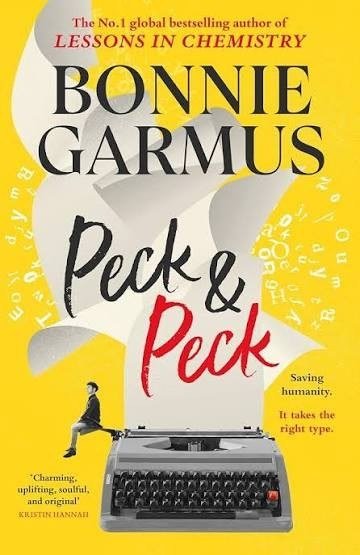
Peck & Peck by — Book Review
| Published | 2006-10-13 |
| Series | Standalone |
| Genre | Literary Fiction, Coming-of-Age, Humorous Fiction |
| Language | English |
| Publisher | Scribner |
| ISBN-13 | 9781668251065 |
📝Epiloguely Editorial Review
Written and reviewed by Shadab Alam.
There is something immediately appealing about a novel that treats poetry as if people might actually fight over it.
In Peck & Peck, Bonnie Garmus takes one of the least commercially sensible passions a young person could choose and builds an entire workplace around people who treat it as a matter of life and death. Batter Gray does not want the career his parents or friends might consider practical. He has an ear for poetry, reads it seriously, and believes words matter enough to organize a life around them.
Unfortunately, belief does not pay student loans.
That tension gives Batter an easy vulnerability from the beginning. He is young, newly out of college, uncertain about the future, and surrounded by people who appear to have chosen more respectable paths. Before Peck & Peck enters his life, his affection for poetry looks less like a gift than a slightly embarrassing refusal to become practical.
Then he gets the job he has wanted.
The joke, naturally, is that dream jobs tend to become ordinary jobs the moment somebody gives you a desk.
Peck & Peck is supposed to represent the highest level of literary seriousness. It is prestigious, secretive, intimidating, and packed with people who have strong opinions about what deserves publication. Batter enters that world at the bottom, handling the work nobody important wants to do while trying not to attract the wrong kind of attention.
That setup is one of the novel's strongest ideas because Garmus understands the contradiction inside creative institutions. A magazine can exist to defend originality while still developing its own bureaucracy, hierarchy, petty rivalries, and ridiculous rules.
Art may be the mission.
Workplace politics still decides who gets invited to lunch.
The staff itself sounds deliberately excessive. There are thirty-nine editors, rival leaders, assistants with their own agendas, and an internal culture where rejecting mediocre poetry is not enough. Bad submissions are literally burned. That exaggeration gives the novel its comic energy, but it also makes a recognizable point about gatekeeping.
People who decide what counts as good art eventually acquire power.
Once that happens, taste stops being entirely innocent.
I like that Batter is not introduced as a literary genius whose greatness everyone else is simply too stupid to recognize. His advantage is attention. He listens. He notices language. He understands poetry instinctively, but he is still capable of making poor decisions, misreading situations, and getting himself into increasingly absurd trouble.
That makes the coming-of-age element more convincing.
Batter is not only trying to prove that poetry matters. He is learning how institutions work, how adults protect status, how loyalty can become dangerous, and how difficult it is to keep believing in an ideal once the people representing it disappoint you.
The Peck brothers appear to embody that contradiction.
A literary journal named after them should suggest unity, but the brothers are rivals rather than partners in any comfortable sense. Their conflict turns the office into a place where aesthetic judgment, ego, and personal history become difficult to separate.
The idea of twins also fits a larger pattern in Batter's life. Advance descriptions reveal that Batter himself was born an identical twin but lost his brother at birth. The novel repeatedly returns to dualities: acceptance and rejection, truth and deception, good judgment and bad judgment, loyalty and self-interest. Google Books
That could have felt overly symbolic, but it makes sense in a novel about editing.
Every submission creates a choice.
Keep it or reject it.
Original or derivative.
Worth saving or worth burning.
The problem, of course, is that human beings rarely divide that cleanly.
The workplace satire seems strongest when Garmus lets that contradiction remain funny. Peck & Peck may claim to worship creativity, but the institution is still full of people competing for authority.
Sources & References
Reader Reviews
0 published written reviews · Reader star ratings remain separate from the editorial rating.
📊Reader Rating Breakdown
🎭Vibe Check
Use the separate comment-style discussion room for spoilers, endings, characters, theories, questions, and replies. Formal reader reviews stay on this page.
Discover Your Next Great Read
Handpicked recommendations from our collection of literary treasures