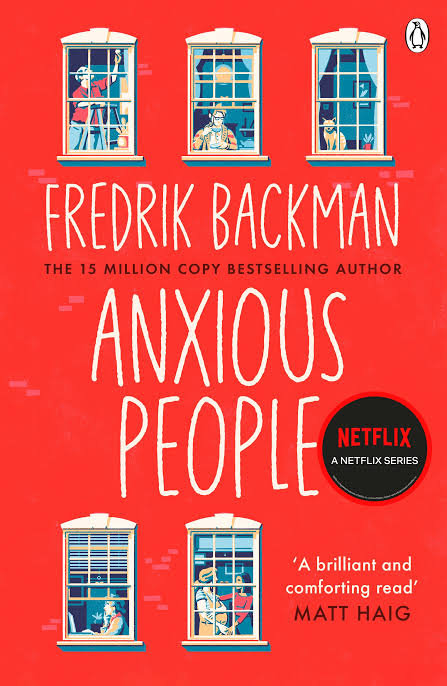
Anxious People book cover by Fredrik Backman
⏱️
Estimated Read Time
8-10 hours

Anxious People Review

✍️ Book by Fredrik Backman
Editorial Rating
★★★★★ 4.5
Epiloguely review by Shadab Alam
Reader Rating
☆☆☆☆☆ 0.0
No reader ratings yet
Rate This Book
A written review is optional
Published2020-09-08
SeriesStandalone
GenreContemporary Fiction, Comedy, Mystery
LanguageEnglish
PublisherAtria Books
ISBN-101501160834
ISBN-139781501160837

📝Epiloguely Editorial Review

Written and reviewed by .

Anxious People begins with a situation that sounds almost absurd: a desperate person attempts to rob a bank, things go badly, and the would-be robber ends up inside an apartment viewing with a group of strangers who suddenly become hostages. At first, the setup feels built for comedy and confusion. The people trapped inside the apartment seem exaggerated, the police investigation keeps producing strange details, and almost everyone behaves badly in one way or another. But the longer the story stays with them, the less interested it becomes in the mechanics of the hostage situation. What begins to matter is why these people behave the way they do when they are frightened, ashamed, lonely, or trying desperately not to admit that something in their lives is falling apart.

The ensemble is one of the book’s biggest strengths. At first, several characters can look like comic types—the difficult couple, the irritating stranger, the nervous person saying the wrong thing—but Backman keeps returning to them until those first impressions become harder to maintain. Their worst qualities are often connected to fear, grief, disappointment, or the need to protect themselves from being hurt again. That does not make every action acceptable, but it makes the people more understandable. I liked that the novel allows sympathy to arrive slowly. It does not ask you to love everyone immediately.

The failed robbery works because it keeps forcing people who would normally avoid one another into the same room. They cannot simply walk away from an uncomfortable conversation or dismiss someone after a bad first impression. As the situation continues, the apartment becomes a strange little pressure chamber where marriages, insecurities, old regrets, and private anxieties start leaking out. The hostage plot is technically the reason everyone is together, but the real tension comes from what each person has been refusing to say.

The father-and-son police relationship adds another layer to that.

Their investigation could have been used only to move the mystery forward, but it becomes part of the book’s larger interest in family and emotional distance. They care about each other, yet they do not always know how to speak honestly. That fits the rest of the novel, where people are often surrounded by others and still feel completely alone.

Suicide is one of the darker threads running beneath the comedy, and it changes the meaning of several scenes once more of the characters’ histories become clear. The book is interested in the way one person’s despair can remain present in the lives of people who survive it. Fear, guilt, responsibility, and helplessness do not disappear simply because time has passed. Some characters carry those feelings quietly for years, and the hostage situation brings them closer to the surface.

That contrast between comedy and pain is where Anxious People can be very effective. One minute, the characters are arguing over something ridiculous; the next, a small detail reveals that someone has been carrying far more than anyone around them realized. The shift can feel abrupt, but it also suits a book about people using humor, irritation, or stubbornness to keep others from seeing how frightened they really are.

I especially liked the way the novel keeps revising first impressions. A person who initially appears selfish may be protecting someone. Someone who seems confident may be terrified. A choice that looks irrational from the outside becomes more understandable once the fear behind it is visible. This compassionate reframing is repeated throughout the book, and although the technique becomes noticeable, it also gives the story much of its warmth.

The structural misdirection is clever too. Information is withheld, assumptions are encouraged, and later revelations force earlier scenes to be reconsidered. Some of those twists worked well for me because they changed how I understood the characters rather than simply surprising me. The hostage situation itself becomes different on reflection once you understand what was actually happening inside the apartment and why certain people behaved as they did.

I did have problems with the way the novel handles emotion at times. Backman clearly wants the reader to feel deeply for these characters, and occasionally the story pushes too hard. A scene can already make its point, then the narration explains the feeling again. That is especially noticeable around the heavier material involving anxiety and suicide. I often preferred the quieter moments, when a pause or an unfinished sentence carried the emotion without needing to be translated for me.

Some of the humor also repeats. The characters’ misunderstandings and exaggerated behavior are funny at first, but a few jokes continue after their purpose is already clear. The same is true of certain twists: because the novel depends so heavily on withheld information, there are moments where the structure becomes visible. Instead of wondering naturally what happened, I sometimes found myself waiting for the book to reveal the fact it was obviously holding back.

Still, the emotional argument underneath the story mostly worked for me. Anxious People is less interested in solving anxiety than in showing how common it can be to hide it. People make bad decisions because they are scared. They say cruel things because admitting vulnerability feels worse. They cling to marriages, jobs, routines, or carefully constructed versions of themselves because change feels dangerous.

What the novel keeps returning to is the possibility that another person can interrupt that isolation.

Not cure it.

Not provide one perfect piece of advice.

Just interrupt it.

A stranger can stay in the room. A family member can finally listen. Someone can notice that another person is not doing well before it is too late. The book’s optimism comes from those small acts rather than from pretending that anxiety or grief can be permanently solved.

That is also why the ridiculous hostage situation ultimately works better than it first appears. A group of people who would probably never have chosen to spend time together are forced to see one another beyond first impressions. By the end, the apartment is less memorable as the scene of a crime than as the place where several people briefly stop pretending they are fine.

Anxious People can be sentimental, and there are moments where its emotional message is stated more clearly than I needed. The twists are not always as invisible as the book wants them to be either. But its compassion for frightened, difficult, imperfect people stayed with me.

The part I remember most is not really the robbery.

It is the idea that almost everyone in that apartment is struggling with something the others cannot initially see, and how differently they begin treating one another once they finally do.

Book Summary

A failed bank robber accidentally takes apartment viewers hostage, and the investigation reveals that nearly everyone present carries private fear. The book becomes most personal when The ensemble first looks like comic types, then becomes a group whose worst behavior is connected to pain. Its wider questions involve anxiety, suicide, parenting, marriage, forgiveness, fear, strangers, and how people interrupt despair, but they remain connected to what the characters risk and lose.

What I Liked

I liked the absurd hostage setup, father-son police relationship, structural misdirection, and compassionate reframing of each person. The ensemble first looks like comic types, then becomes a group whose worst behavior is connected to pain. Those details gave Anxious People a distinct emotional shape, and the writing trusted the scenes instead of explaining every idea twice.

What Could Be Better

My main problem was that the sentiment can be heavy, twists depend on withheld information, and some jokes repeat. Anxious People remained readable, but those choices reduced the force of scenes that should have landed harder.

Context Behind the Book

Fredrik Backman writes about difficult, lonely, or grieving people slowly pulled into community, mixing broad humor with direct emotional appeals.

Reader Reviews

0 published written reviews · Reader star ratings remain separate from the editorial rating.

No reader reviews yet Be the first reader to share a thoughtful review of at least 100 words. A quick star rating can still be submitted separately above.

📊Reader Rating Breakdown

0.0
★★★★★
No reader ratings yet

No reader ratings yet. Be the first reader to rate this book using the separate quick-rating stars above.

🎭Vibe Check

What's the vibe of this book?
💬 Open Reader Comments & Discussion

Use the separate comment-style discussion room for spoilers, endings, characters, theories, questions, and replies. Formal reader reviews stay on this page.