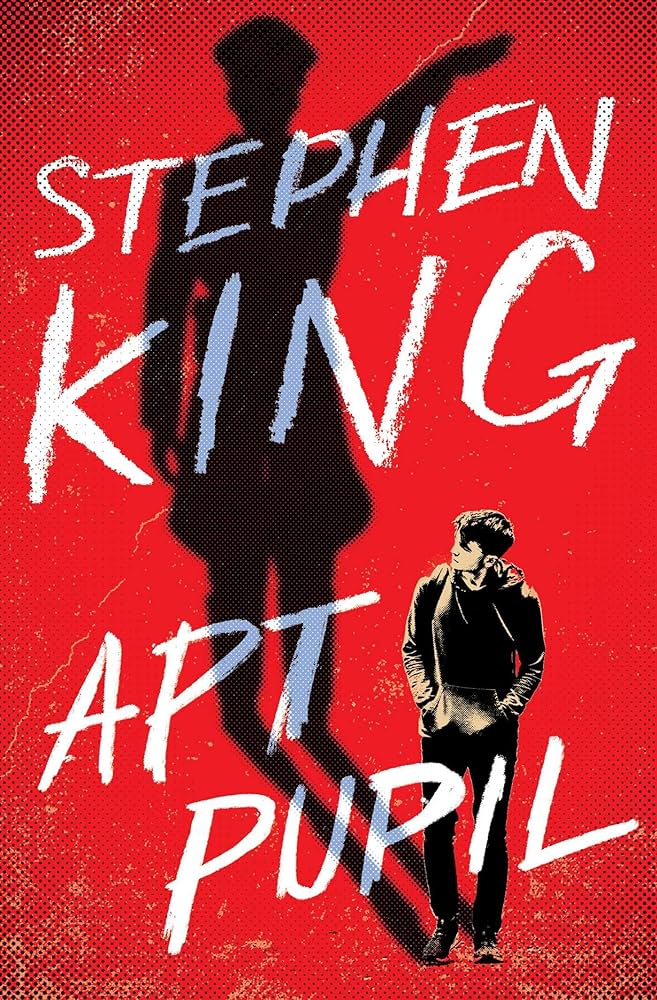
street? Not a boy from a thriller, not a heroic protagonist designed to make the right choice, but an actual thirteen-year-old with ordinary anxieties and an above-average intelligence and a fascination with the Holocaust that he has never quite been able to explain even to himself. King's answer is disturbing and, once you sit with it, completely believable.
The relationship between Todd and Dussander is the engine of the entire novella, and King gives it a complexity that lifts the story far above the level of a simple cautionary tale. These are not hero and villain. They are not even victim and perpetrator, though those categories do apply at different points in the story. They are two people who recognize something in each other across a generational and historical gap that should make them incomprehensible to one another. Dussander sees in Todd more than a threat but a mirror, a young man who has the same capacity for detachment and cruelty that Dussander himself discovered in himself decades earlier under very different circumstances. Todd sees in Dussander more than a subject of morbid fascination but a permission structure, an old man who did the things Todd only imagines and survived them, and who is still here, still thinking, still alive and apparently functional. Their arrangement begins as blackmail and becomes something far more complicated and far more troubling than either of them intended.
The ending is not redemptive. It is not punishing in the way morality tales demand. It is something stranger and more honest, a final image that is simultaneously logical and deeply unsettling, the last frame in a portrait of something that grew and grew and was never named until it was too large to contain.
King is doing something very serious here about the transmission of evil, about how fascination shades into complicity shades into participation without any single moment where a person could point to a clear line being crossed. Todd does not decide to become a killer. He slides into it through a series of small accommodations, each of which seems manageable, each of which makes the next one slightly easier. It is one of the most psychologically precise portrayals of moral collapse in King's entire body of work, and it is all the more effective for being written with complete narrative calm, no hysteria, no authorial judgment forced on the reader, just the steady documentation of a process.
The structure of the novella, which covers several years and is organized in monthly chapters that jump forward in time, is perfectly suited to this kind of slow rot.
Apt Pupil is not comfortable reading. It is not meant to be.
Book Summary
Todd Bowden is thirteen years old, blond-haired, blue-eyed, academically gifted, and by every outward measure the perfect all-American boy. One afternoon he rides his bicycle to the front door of an elderly German immigrant named Arthur Denker and tells him, quietly and without drama, that he knows who he really is. The old man is Kurt Dussander, a former Nazi war criminal who presided over atrocities at a concentration camp during the Second World War and has been living under a false identity in a California suburb for decades. Todd does not want to call the police.
He does not want to do the right thing. He wants Dussander to tell him everything, in as much detail as possible, about what happened in the camps.
What I Liked
The relationship between Todd and Dussander is one of the most psychologically complex things King has ever written, genuinely unsettling in ways that stay with you long after the story ends. The slow, incremental nature of Todd's corruption is portrayed with a precision and patience that most horror writers never attempt.
King's refusal to moralize or editorialize keeps the story honest and keeps the reader uncomfortably close to the material. And the final image of the novella is quietly one of the most disturbing endings in his entire catalog.
What Could Be Better
The third act, once the story begins moving toward its conclusion, loses a small amount of the intimate, claustrophobic quality that makes the first two thirds so powerful, spreading its focus across a wider set of events and characters in ways that slightly dilute the central dynamic. Some readers also find the level of detailed description of concentration camp atrocities, which Dussander narrates to Todd throughout the story, difficult to get through, which is understandable, though those passages are entirely deliberate and serve the story's purposes.
Context Behind the Book
Stephen King wrote Apt Pupil in the mid-1970s, shortly after completing The Shining, and published it as part of the Different Seasons collection in 1982 alongside Rita Hayworth and Shawshank Redemption, The Body, and The Breathing Method. He has described it as a deliberate attempt to write something serious and sustained outside the horror genre, and as an exploration of what he called the "evil that men do." It was adapted into a 1998 film directed by Bryan Singer and starring Ian McKellen as Dussander and Brad Renfro as Todd.