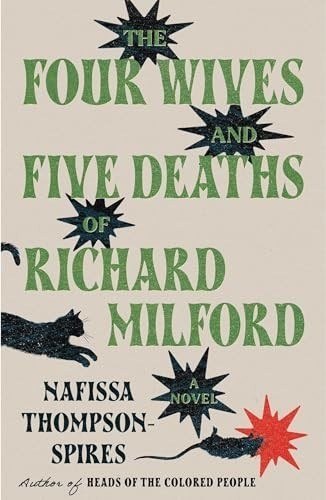
The Four Wives and Five Deaths of Richard Milford wastes very little time pretending Richard Milford was a good man. He has money, influence, a successful moonshine operation, and a habit of treating women and townspeople according to whatever suits him at the moment. By the time he dies, the more surprising question is not whether someone wanted him dead but how anyone could narrow the list down. Nafissa Thompson-Spires uses that setup for comedy, but the humor never turns the characters into simple jokes. Richard may sit at the center of the mystery, yet the women around him quickly become far more interesting than the man everyone is supposedly investigating.
The four wives are the novel’s greatest strength because Thompson-Spires gives each woman a different relationship to Richard and to the life he has built around himself. Lally, Sophronia, Georgette, and Vivianne are not merely four suspects waiting for their chapters; each understands Richard from an angle the others cannot completely see. Their accounts overlap, contradict, and occasionally confirm one another, which means the reader keeps gaining information without ever receiving one perfectly authoritative version. That structure makes the book feel closer to gossip passed through a community than to a traditional detective novel. The truth exists, but it has been divided among too many people for anyone to own it comfortably.
Newville itself is just as important as the wives. Thompson-Spires places the story in a self-sufficient Black town in 1920s Oklahoma, not far removed in time and geography from the Tulsa Race Massacre, yet she refuses to let racial terror become the only thing defining the community. People in Newville gossip, compete, make money, fall in love, resent one another, and develop strong opinions about everyone else’s business. That normal social messiness gives the historical setting life. The town feels like a community rather than a backdrop designed only to illustrate oppression, while the outside danger and economic realities of the period remain present around its edges.
The novel is also much funnier than the murder premise suggests. Richard repeatedly becomes the target of people whose patience with him has run out, and the title’s reference to his “five deaths” gives the story an increasingly absurd rhythm. Thompson-Spires uses that comedy to expose Richard’s entitlement rather than to soften it. His money, masculinity, bootlegging success, and ability to move between women have allowed him to imagine that ordinary consequences apply mainly to other people. The women’s frustration therefore becomes both funny and understandable, especially as their separate attempts to manage Richard begin colliding with one another.
Under the comedy is a sharper argument about power. Richard’s wealth comes from land, oil, moonshine, and the labor of people around him, while his relationships depend on women performing different kinds of emotional and practical work. Publishers Weekly particularly noted the novel’s attention to capitalistic excess, male chauvinism, and debates over individual advancement within Black communities. Those ideas could have made a 176-page book feel overloaded, but Thompson-Spires mostly keeps them inside character and circumstance rather than pausing the story for explanation. The satire works because Richard’s personal behavior and the larger ideas about success around him are connected.
My only real reservation is that the book’s short length sometimes works against the women it makes so interesting. Six perspectives in fewer than two hundred pages create speed and energy, but I occasionally wanted more time with individual characters before the story moved to another version of events. The intentionally exaggerated structure also means readers looking for a tightly procedural mystery may find the murder mechanics less important than expected. This is much more interested in why people tell stories differently than in giving us a detective who sorts every clue into order. That choice suits the novel, though it also explains why I enjoyed it more as dark historical satire than as a conventional whodunit.
What stayed with me was the idea that several people can tell the truth and still produce completely different stories. Richard is husband, employer, father, lover, local celebrity, nuisance, and threat depending on who is speaking, and none of those identities fully cancels the others. Thompson-Spires turns that instability into the book’s central pleasure: every new voice changes the shape of what came before.