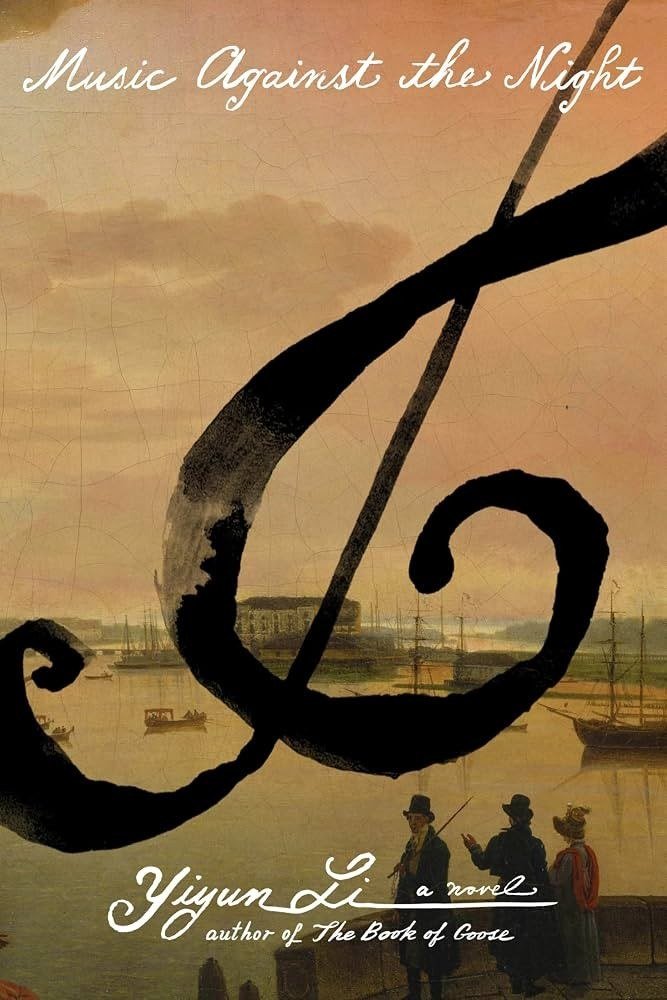
Music Against the Night is strongest when it treats musical talent as both a gift and a form of pressure. John Field grows up surrounded by adults who see extraordinary ability in him and quickly turn that ability into an expectation. Practice, performance, reputation, and the possibility of becoming another Mozart take over the space where an ordinary childhood might have existed. Li does not romanticize the idea of the prodigy; she is much more interested in what happens when a child becomes valuable because of what he can produce.
Adelaide’s story provides a very different version of the same problem. She is intelligent, observant, and increasingly drawn to the pianoforte, but she lives in a world where a woman’s musical education is often treated as decoration rather than a serious path. Her movement from Pondicherry toward Paris and eventually Moscow becomes a struggle not only for artistic opportunity but for the right to imagine a larger life at all. The contrast between John and Adelaide works because both are limited by their circumstances, though the limits take very different forms.
The historical setting is one of the novel’s main strengths. Revolution, war, class, colonialism, and changing artistic culture remain present without completely overwhelming the characters. Li makes the period feel unstable, particularly for young people whose futures depend on patrons, teachers, family decisions, money, and reputation. Music can offer freedom, but it can also create another hierarchy in which talent is judged, sold, disciplined, and compared.
I especially liked the way Li writes about ambition. John and Adelaide both want music badly, but wanting the same thing does not mean they are given the same opportunities or that success means the same thing to them. John fears wasting a gift others have already declared exceptional, while Adelaide has to fight for the chance to be taken seriously in the first place. Their stories make artistic greatness feel less like a beautiful destiny and more like a difficult bargain involving time, family, loneliness, and sacrifice.
The novel is less satisfying when its structure becomes too fragmented. It moves between the two lives and occasionally looks ahead to what will happen later, which creates an interesting sense of fate but also reduces some of the tension. Because the book spends so much time preparing John and Adelaide to meet, their eventual connection can feel more like the end of a long first movement than a complete emotional resolution. That makes sense once you know this is the opening volume of a trilogy, but readers expecting a fully self-contained historical romance may find the ending restrained.
Even with that reservation, the character work gives the book real weight. John’s talent does not protect him from insecurity, and Adelaide’s intelligence does not magically remove the restrictions surrounding her. Li allows both characters to be ambitious without turning ambition into either a virtue or a flaw. What matters is what they are willing to sacrifice for the lives they imagine, and whether the success they pursue will actually belong to them once other people begin defining it.
What stayed with me most was the idea of artistic legacy. John Field creates music important enough to influence later composers, yet historical memory is selective, and Adelaide faces the even greater risk of disappearing almost entirely from the record. Music Against the Night asks whether art can protect someone from being forgotten, while also showing how easily history can remember the work more clearly than the person who made it. Rating: 4.4/5. The structure occasionally feels scattered and the ending is intentionally incomplete, but the treatment of talent, gender, ambition, and the cost of artistic life makes this an absorbing start to the trilogy.
What I Liked
The strongest element is the parallel between John and Adelaide. Their lives show two different ways talent can become a burden: one child is pushed too hard because his gift is recognized, while the other must fight because hers is not given the same value. I also liked the historical atmosphere and Li’s refusal to make artistic ambition automatically noble. Music gives both characters possibility, but it also exposes them to exploitation, competition, loneliness, and difficult compromises.
What Could Be Better
The scattered timeline occasionally weakens the emotional momentum, especially because glimpses of the future reveal where some relationships are heading before the main narrative reaches them. The ending also feels more like the conclusion of a first volume than a completely finished arc. That is understandable for a trilogy opener, but readers expecting the relationship between John and Adelaide to receive major development in this book may be surprised by how late their stories actually come together.
Context Behind the Book
Yiyun Li is a Chinese American novelist, short-story writer, memoirist, and professor at Princeton University. Her books include The Book of Goose, Where Reasons End, Must I Go, The Vagrants, and Wednesday’s Child, along with the memoirs Dear Friend, from My Life I Write to You in Your Life and Things in Nature Merely Grow. Her work has received honors including the PEN/Faulkner Award, PEN/Malamud Award, MacArthur Fellowship, Windham-Campbell Prize, and Pulitzer Prize. Music Against the Night begins her historical-fiction sequence known as The Nocturne Trilogy.