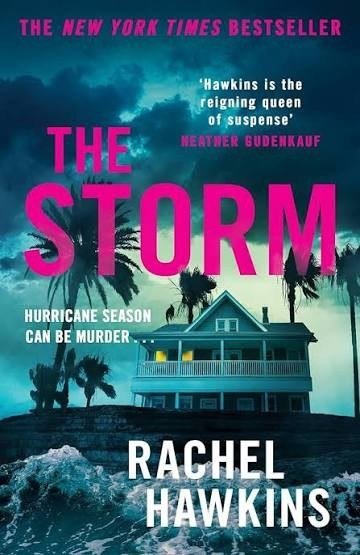
The Storm has exactly the sort of setting Rachel Hawkins handles well: a beautiful place that becomes less inviting the longer you stay there. St. Medard’s Bay is a Gulf Coast town shaped by tourism, old families, humid summers, and hurricanes that periodically tear through the landscape and rearrange people’s lives. At the center sits the Rosalie Inn, a century-old hotel that has somehow survived every major storm while the family responsible for it has accumulated its own history of damage. Hawkins does not need to make the building supernatural for it to feel haunted. The ghosts here are reputation, money, memory, and stories people have been repeating for so long that nobody remembers which parts were ever proven.
Geneva Corliss is a useful way into that world because she initially looks at August Fletcher’s arrival in practical terms rather than as the beginning of a mystery. The Rosalie Inn is struggling financially, and a journalist staying for an extended period could mean badly needed money and publicity. When August arrives with Lo Bailey, however, the booking becomes much more complicated than Geneva expected. Lo is not simply a guest; she is the woman whose name has been attached to St. Medard’s most famous scandal for more than forty years. Geneva’s interest gradually shifts from what Lo’s story might do for the inn to what actually happened during Hurricane Marie, and that change feels natural because the old case begins touching parts of Geneva’s own family history.
Lo is the character who gives the novel most of its electricity. She was nineteen when Landon Fitzroy died, but the version of her preserved in newspaper stories and local gossip never really aged beyond that scandal. She has spent decades being described through somebody else’s interpretation: mistress, suspect, victim, opportunist, or killer depending on who happens to be telling the story. Returning to St. Medard’s Bay gives her a chance to challenge that history, although Hawkins is careful not to make her motives completely transparent. Lo may genuinely want to reclaim her story, but Geneva is right to wonder whether correcting the record is the only reason she has finally come home.
The true-crime angle works because the novel is interested in who gets to construct a version of the past. August believes he is documenting Lo’s story, Geneva starts developing theories of her own, old newspaper coverage carries assumptions from 1984, and people who were actually present remember events differently. Hawkins folds letters, articles, emails, and excerpts from August’s developing manuscript into the narrative, so the reader keeps encountering the case through documents that appear authoritative while still being shaped by whoever created them. Publishers Weekly specifically praised this approach, noting how Hawkins uses those different materials to raise new questions while moving between the past and present timelines. PublishersWeekly.com
The hurricanes are more than an obvious thriller countdown. Hawkins structures much of the book around different storms, connecting personal turning points with moments when the physical landscape was also being destroyed and rebuilt. A hurricane creates confusion, broken communication, damaged evidence, frightened people, and the possibility that almost any death can initially be explained by the weather. It also changes a town afterward, sometimes physically and sometimes economically, which means the St. Medard’s Bay of Geneva’s present is not exactly the place Lo left decades earlier. That parallel between environmental destruction and the damage people cause one another can occasionally be a little obvious, but the setting is atmospheric enough that it rarely feels decorative.
The 1984 material is especially effective because the case already looks suspicious before Hawkins begins adding twists. Landon is older than Lo, married, politically connected, and the son of Alabama’s governor, while Lo is a nineteen-year-old local woman who becomes a convenient figure for the public to blame. The imbalance of power matters as much as the question of whether she killed him. A sensational story about a young mistress and a dead politician’s son is much easier to sell than a complicated examination of who had influence, who controlled the narrative afterward, and why certain versions of events became more believable than others. The novel is at its best when the mystery and those social pressures remain tangled together rather than when it is simply arranging clues for a final reveal.
Geneva’s family history adds another layer because she gradually discovers that she is not standing outside this old scandal. Her connection to Lo and to people who knew what happened in 1984 means that every new piece of information has the potential to rearrange something she thought she understood about her own life. That gives the investigation personal stakes without turning Geneva into a professional detective overnight. She is curious, financially anxious, increasingly suspicious, and sometimes too willing to keep digging because the mystery gives her something to focus on besides the failing inn and the less glamorous problems waiting in her present. I liked that she occasionally makes questionable choices rather than behaving with the perfect caution of someone who knows she is inside a thriller.
The friendship history surrounding Lo also gives the story more depth than a simple cold-case investigation would have had. Hawkins is interested in the way people who grew up together can know one another intimately while still holding resentments, jealousies, or secrets that survive for decades. Childhood closeness does not automatically become adult loyalty, particularly when class, romantic relationships, and public scandal change the balance between people. The old relationships in St. Medard’s Bay therefore become another kind of evidence, although they are much harder to interpret than newspaper reports. A person may lie because they committed a crime, but they may also lie because they loved someone, hated someone, wanted to protect a reputation, or simply cannot bear to admit what they allowed to happen.
The alternating timeline is effective overall, although this is also where the book occasionally loses momentum. Moving between the present-day investigation and earlier storms creates suspense because each period answers questions raised by the other, but some flashback sections run long enough that Geneva’s immediate story temporarily loses urgency. One sharply negative review criticized the novel for repetition and for allowing some historical sections to slow the central mystery, while the more positive professional reviews saw the same multi-timeline structure as one of the book’s strengths. I fall somewhere between those responses: the past is necessary and often interesting, but a tighter middle section would have kept the pressure of the approaching present-day hurricane more constant. PublishersWeekly.com
Another limitation is that some of the mystery’s turns are easier to anticipate than Hawkins probably intends. Kirkus made a similar observation, noting that several developments can be predicted even though the story remains gripping. The novel contains enough suspicious people and competing accounts to keep the exact picture uncertain, but readers who regularly read domestic and gothic thrillers will recognize some of the methods being used to redirect attention. The good news is that Hawkins does not rely entirely on a single shocking reveal. The pleasure comes from seeing how the different pieces fit together and how an old public story changes once the voices excluded from it finally get space. Kirkus Reviews
August is probably the least developed member of the central group. His role as writer gives Hawkins a useful way to comment on true crime and the transformation of real suffering into a marketable narrative, but compared with Geneva and Lo, he sometimes feels more functional than fully complicated. Kirkus also singled him out as the relatively one-note character among a stronger ensemble. I wanted slightly more uncertainty around what writing the book meant to him personally, because a journalist helping someone reclaim her reputation can still have professional ambitions that complicate the ethics of the project. The story hints at that tension, but Lo and Geneva remain much more interesting whenever the three characters share a scene. Kirkus Reviews
The strongest theme, for me, is the difference between legal innocence and social innocence. Lo was acquitted, yet that did not erase the version of her that newspapers and gossip had already created. Once a scandal becomes entertaining enough, evidence can matter less than repetition, especially when the person being discussed does not possess the same institutional power as the people around her. Hawkins turns that into an effective true-crime criticism without making the novel feel like an essay about media ethics. The question underneath the mystery is simple but uncomfortable: if everyone already believes they know what happened, how much power does the truth actually have when it finally arrives?
Geneva’s interest in turning the Rosalie Inn into something that might benefit from the renewed attention adds an especially uncomfortable wrinkle. True crime can create money, tourism, podcasts, books, documentaries, and curiosity around places connected to violence. For someone trying to keep a historic hotel alive, that attention can look like an opportunity even when it originates in another person’s worst experience. Hawkins does not turn Geneva into a monster for thinking practically about this; that would be too easy. Instead, the book lets financial desperation sit beside genuine curiosity and moral discomfort, which makes her participation in Lo’s story much more believable.
The approaching hurricane eventually gives the later chapters the physical urgency the earlier investigation has been building toward. Hawkins is good at using weather to narrow the characters’ options, isolate people, and turn an already unstable situation into one where mistakes suddenly become dangerous. By that stage, the storm is not creating the novel’s conflict so much as removing the ordinary structures that had been keeping the conflict contained. The town has survived hurricanes before, but survival is not the same thing as emerging unchanged. That idea applies equally well to Lo, Geneva, the Rosalie Inn, and the secrets St. Medard’s Bay has carried since 1984.
What makes The Storm enjoyable is that Hawkins understands the book does not need to become unbearably grim simply because it deals with murder, political influence, exploitation, and damaged lives. There is a pulpy quality to the plotting, and the novel seems comfortable being entertaining while also asking sharper questions about memory and reputation. Booklist, as quoted by the publisher, similarly described the book as quick and enjoyable, emphasizing its multiple timelines and characters. That tone will probably work best for readers who enjoy gothic suspense with soapier interpersonal complications rather than readers looking for a bleak psychological crime novel. Macmillan
I also appreciated that the Rosalie Inn feels connected to the story rather than merely chosen because an old hotel sounds gothic. It represents inherited responsibility for Geneva, a possible source of financial rescue, and a physical link between different generations of the town. Buildings like this survive partly because people keep deciding they are worth saving, even when maintaining them becomes irrationally expensive. That makes the hotel a useful counterpart to the town’s obsession with its own history. Both contain things people want to preserve, things they would rather hide, and stories that become more polished every time they are repeated.
By the time the mystery comes together, the most satisfying part is not simply learning what happened to Landon Fitzroy. The more interesting shift is seeing how many people benefited, intentionally or not, from the old version of events remaining intact. Hawkins is careful enough with the structure that earlier details take on new meaning once the larger picture is visible, which is why even some predictable individual twists do not completely weaken the ending. Publishers Weekly praised the way the separate storylines eventually click into place, and that describes the payoff well. The solution feels constructed, certainly, but it also feels connected to the people and relationships the novel has spent time establishing.