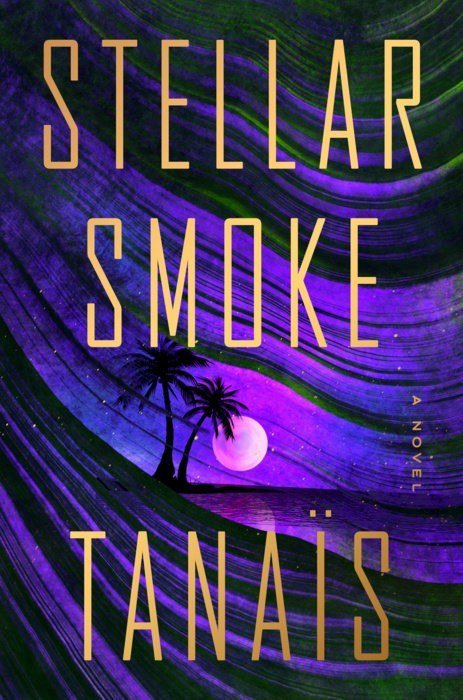
Stellar Smoke begins with Qamar already feeling displaced from her own life. Her music is not providing financial security, her relationship has collapsed, and the city around her feels increasingly difficult to inhabit. Returning to the island is therefore less a homecoming than a decision made because the alternatives have run out. Tanaïs uses that instability well, because Qamar arrives carrying resentment toward her mother and the spiritual community that shaped her childhood, only to discover that the people she expected to confront are gone.
The introduction of VEDA gives the novel its most unusual idea. This artificial intelligence is not simply a convenient database or futuristic assistant; it has been built from Veda’s memories, personality, and years of collected material. Through it, Qamar begins moving through generations of family history, including migration, political upheaval, spiritual searching, abuse, desire, and the creation of the Endless Temple. The technology therefore becomes both an archive and a deeply uncomfortable substitute for intimacy, because Qamar can finally ask questions of something that sounds like her mother without knowing whether the answers belong to the woman herself.
Tanaïs is especially good at writing the physical side of memory. Music, perfume, smoke, heat, bodies, food, and landscape keep the story from becoming an abstract debate about artificial intelligence. Qamar experiences the past almost sensorially, and that makes the virtual material feel more personal than a simple series of recorded flashbacks. The book is also interested in how families preserve their own myths, particularly when charismatic people begin turning private beliefs into public movements. Veda can be visionary, controlling, loving, and destructive without the novel forcing those qualities into one clean judgment.
The middle section is where the book becomes less controlled. VEDA reveals so much family history that the immediate mystery surrounding Veda and Palo sometimes loses urgency, and the novel can feel more interested in its archive than in Qamar’s present situation. This is also where the book’s ambition becomes most visible: colonial history, spirituality, sexuality, technology, cult dynamics, family trauma, and environmental decline are all competing for space. Much of that material is fascinating, but a tighter selection would have made the missing-person storyline feel more urgent.
What keeps the novel together is Qamar’s relationship with the idea of her mother. She has spent years trying to separate herself from Veda, yet the machine forces her to discover how much of her own identity was built in response to that relationship. The AI cannot repair the past, but it can expose how incomplete Qamar’s understanding of it has been. That distinction gives the technology emotional purpose instead of using AI only as a fashionable speculative device.
The final section becomes stranger and more openly speculative, which may divide readers who prefer the grounded atmosphere of the opening chapters. I liked the willingness to let the story become less predictable, although the transition is not always smooth.
What I Liked
The strongest idea is VEDA itself. Using an AI reconstruction of Qamar’s mother allows the novel to explore memory, grief, family stories, and technology at the same time without reducing any of them to a simple warning about artificial intelligence. I also liked the sensory writing and the way music, scent, landscape, and physical memory remain important even when the story moves into virtual spaces.
What Could Be Better
The middle section becomes crowded with family history, and some of the virtual sequences continue longer than the immediate mystery can comfortably support. Veda and Palo’s disappearance is compelling enough that I occasionally wanted the novel to return to it sooner. The final shift into stranger speculative territory is interesting, but it may feel abrupt for readers who become most invested in the grounded family mystery.
Context Behind the Book
Tanaïs, formerly published as Tanwi Nandini Islam, is a multidisciplinary writer, perfumer, and artist. Their debut novel Bright Lines was a finalist for several debut-fiction prizes, while In Sensorium: Notes for My People won the Kirkus Prize for Nonfiction. Their work frequently explores South Asian identity, queer life, memory, scent, migration, and the relationship between the body and history. Stellar Smoke brings those interests into speculative fiction through artificial intelligence, family archives, and a near-future setting.