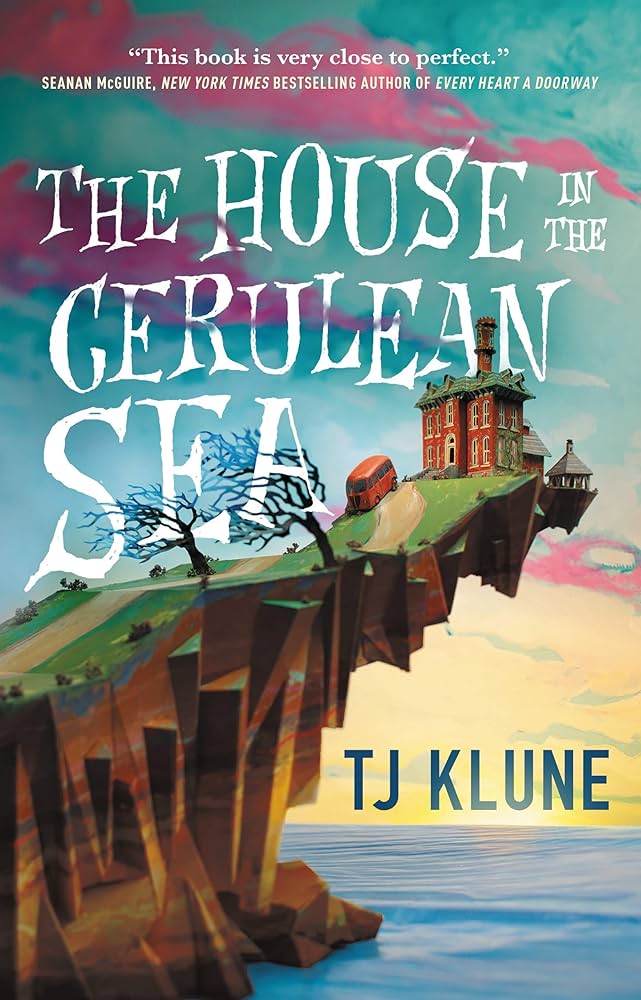
I admired The House in the Cerulean Sea before I completely fell for it.
The premise is easy to understand. Linus Baker works for the Department in Charge of Magical Youth, where his job is to inspect homes containing magical children and report whether everything follows the rules. He is careful, lonely, and extremely comfortable with procedure.
Then he is sent to Marsyas Island.
The children living there have been described in ways that make them sound dangerous. One is a gnome. Another is a wyvern. One of them happens to be the Antichrist.
That last detail tells you a lot about the book's sense of humor.
What matters, though, is how quickly those descriptions stop being useful once Linus actually meets the children.
Lucy may technically be the son of the Devil, but he is also a child who likes dramatic threats and wants people to pay attention to him. Talia is blunt, funny, and deeply attached to her garden. Chauncey dreams of becoming a bellhop. The more time Linus spends with them, the harder it becomes for him to treat them as categories inside a government file.
That is where the book found its emotional center for me.
Linus does not become brave overnight. At first, he keeps trying to observe the island professionally. He takes notes. He worries about procedure. He reminds himself that he is there to evaluate the home, not become part of it.
But the children make that distance difficult.
He sees how often they have already been judged before anyone meets them. He notices how much effort Arthur puts into making the house feel safe. Slowly, the question changes from whether the orphanage is following the rules to whether the rules deserve to be followed at all.
Arthur is especially important to that shift.
He is warm without being passive, and protective without treating the children as fragile. He knows exactly what the outside world thinks of them, which is why his kindness never feels completely soft. There is anger beneath it.
I liked that.
The developing relationship between Linus and Arthur is quieter than I expected, and I think that helps. Their connection grows through trust and domestic familiarity rather than constant romantic tension. The book is much more interested in Linus discovering a life he might actually want than in turning the romance into a separate dramatic plot.
The found-family element works for the same reason.
The island gradually becomes meaningful through repetition. Breakfasts. Arguments. Lessons. Walks. The children interrupting conversations at exactly the wrong moment. Nothing about those scenes is especially complicated, but together they make the house feel lived in.
That warmth is also where some of my hesitation begins.
The book wants very clearly to make a point about prejudice. People fear the children because they are different. The government classifies and monitors them. Linus eventually sees that the institution claiming to protect magical children may actually be causing much of the harm.
I agree with the direction of that argument.
I just wish the book occasionally made it harder.
The bureaucracy is often presented as so obviously absurd or cruel that Linus rarely has to confront a genuinely difficult moral choice. Once he understands the children, there is not much reason left to believe in the system he represents.
A messier version of that conflict might have interested me more.
The novel's use of institutional prejudice has also been criticized because a comforting fantasy about magical orphanages can brush against much darker real histories without carrying the same weight. That criticism is difficult to completely ignore, especially when the story moves toward warmth and healing so deliberately.
Inside the book itself, though, the children remain convincing enough that the message rarely felt completely hollow to me.
The quieter moments were usually the strongest.
Linus noticing that one child expects rejection. Arthur choosing to protect someone without making a speech about it. A conversation around the house where a rule suddenly sounds ridiculous because you can see exactly who it harms.
Those scenes did more for me than the larger statements about tolerance.
By the end, I was much more invested in the people than in the allegory.
That is probably why I still liked the book despite my reservations. The House in the Cerulean Sea is not especially subtle about who deserves compassion. It does not make bureaucracy complicated, and it often chooses reassurance over discomfort.
But the children are memorable.
And Linus's gradual realization that a rule can be perfectly official and still be wrong gives the story enough emotional truth to carry its simpler parts.
If I recommend it, that is what I would recommend it for: the children, the island, and the slow transformation of a man who has spent years trusting paperwork more than people.