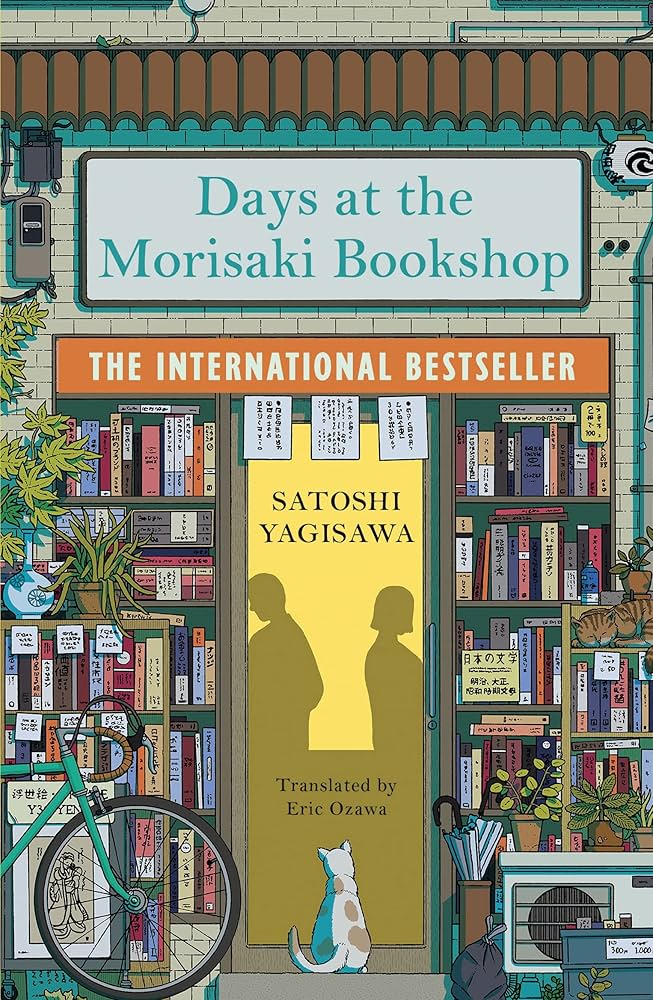
Little by little, the life she had stopped caring about becomes interesting enough to participate in.There is something believable about that.Sometimes recovery is not a huge decision. Sometimes it is getting out of bed, having coffee somewhere, recognizing the same person behind a counter, or finding yourself unexpectedly interested in what happens on the next page.
The bookshop setting naturally helps with that.I enjoyed the scenes where Takako simply spends time among the shelves or explores the surrounding district. The novel does not try very hard to convince us that books are sacred or life-changing. They are just there, part of the neighborhood and part of her new routine.That made the reading element feel more convincing to me.Her uncle also gives the story much of its warmth.He initially seems like the eccentric relative who talks too much and takes life less seriously than Takako does. But the longer she stays with him, the more obvious it becomes that his humor is covering problems of his own.
That kept their relationship from feeling one-sided.Takako is not simply the broken younger person being rescued by a wise older relative. Her uncle has his own unfinished grief, and the book becomes more interesting when she begins noticing that.Their connection is affectionate, but not perfectly smooth. They misunderstand each other. They get irritated. They sometimes avoid saying what actually matters.I liked those moments more than the more openly emotional scenes.The novel is strongest when it allows ordinary routine to carry the feeling.A conversation in the shop. A walk through the neighborhood. Someone returning after being gone for a while. Takako realizing that she has become attached to a place she originally wanted to escape.
None of this is huge.That is the point.At the same time, the book’s small scale occasionally worked against it for me.Some conflicts are introduced and then move toward resolution surprisingly quickly. Considering how patient the novel is with Takako’s early sadness, I wanted that same patience in a few of the later relationships.There were moments when I could see the emotional destination before the characters had really done enough to reach it.The plot is also very light.If someone goes into Days at the Morisaki Bookshop expecting a major romance, a complicated family drama, or a story full of twists, I can easily imagine them wondering when something is going to happen.For me, that was not a major problem because I liked the quietness of it.Still, “quiet” and “slight” are very close neighbors, and the novel occasionally crosses that line.
What stayed with me most was Takako’s relationship with the place itself.The bookshop is not presented as her permanent answer to everything. It is more like somewhere she is allowed to stop for a while. She arrives exhausted and directionless, and during her time there she becomes curious again.I think that is a more interesting version of recovery than giving her a completely new life by the final page.Sometimes you do not need to know exactly where you are going next.You just need to want to go somewhere.
Book Summary
After a breakup leaves Takako emotionally drained and unsure what to do next, she moves into the small room above her uncle’s secondhand bookshop in Tokyo’s Jimbocho district. At first, the shop feels more like a place to hide than somewhere she belongs.
That changes slowly.
As Takako begins reading, helping around the shop, and spending more time with her eccentric uncle, the routines of the place start pulling her back toward life. Days at the Morisaki Bookshop is less about dramatic reinvention than about small recoveries: finding curiosity again, reconnecting with family, and realizing that sometimes a new beginning can be as simple as having somewhere to go each morning.
What I Liked
I liked how modest Takako’s change feels. She does not wake up one day completely healed or suddenly become a different person. Her recovery comes through ordinary things—sleeping, reading, working in the shop, talking to her uncle, and gradually becoming interested in the world around her again.
The setting also does a lot of the work. The used-book district gives the novel a personality beyond the breakup story, especially because books are treated as part of daily life rather than as magical objects that solve everything. Takako simply starts reading more, and that curiosity opens something in her.
Her uncle was another strong part for me. He is funny and slightly chaotic, but there is sadness underneath that humor. Their relationship keeps the book warm without becoming overly sentimental.
What Could Be Better
The novel is very slight, and that will either be part of its charm or its biggest weakness depending on what you want from it. There is not much conflict, and several emotional developments happen faster than I expected considering how quietly the book begins.
A few later conversations also feel as though they are trying to resolve feelings that probably needed more time. Because the story is so understated, those quicker emotional turns stand out more than they might in a busier novel.I still enjoyed the book, but I occasionally wanted it to linger a little longer before moving on.
Context Behind the Book
Satoshi Yagisawa sets these stories in Tokyo's Jimbocho district, an area famous for secondhand bookshops and literary culture.