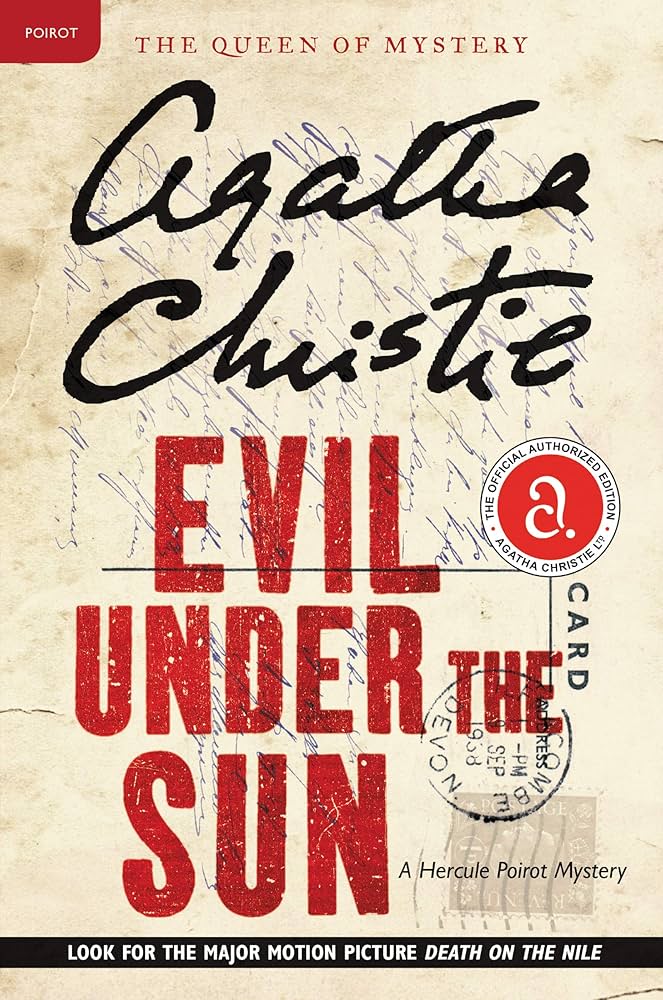
Evil Under the Sun is the kind of Christie that reminds you why she has been in print for over a century without interruption. It is not her most psychologically complex work. It is not her most emotionally devastating. But as a piece of pure mystery craftsmanship, it is very close to perfect, a book that gives you everything the genre promises and then delivers the solution with a precision that makes you feel simultaneously delighted and slightly foolish for not seeing it sooner.
The setting deserves a great deal of credit for what the book achieves. Smugglers' Island and the Jolly Roger Hotel are Christie at her best as a scene-builder. The island is deliberately sealed off from the mainland, reachable only by boat, which creates a natural pressure cooker for the people confined to it. The sun, the beaches, the summer holiday atmosphere give the whole book a surface warmth that sits in deeply uncomfortable contrast with the jealousy and calculation and barely suppressed hostility running underneath every conversation at the dinner table. Christie has always been good at using pleasant settings to make unpleasant truths feel more disturbing, and here she is working at full power.
The other guests are drawn with Christie's characteristic efficiency. Patrick Redfern, the man having the affair, is charming and convincing in a way that immediately makes you slightly uneasy, which is also exactly the point. Christine Redfern, his wife, is the sort of quietly suffering woman Christie was very good at rendering without sentimentality. Kenneth Marshall, Arlena's husband, is steady and decent and therefore almost entirely opaque, which is a technique Christie uses more often and more deliberately than she is usually given credit for. The other guests orbit the central drama with varying degrees of involvement, and Christie uses the social dynamics of the holiday hotel with real wit.
The central trick of the novel is one of Christie's most purely mechanical, which is both its greatest strength and its one real limitation. When the solution is revealed, the cleverness of the construction is immediately apparent. It is a puzzle of timing, of how time of death was manipulated, and Christie lays the clues for it with immaculate precision. Every piece of information you need is present. The problem is that the solution depends on a level of premeditation and physical coordination that strains credibility slightly, a point even the New York Times review at the time noted. Christie was aware of this kind of criticism and never found it entirely fair, and she was not entirely wrong. The ingenuity of the mechanism is its own justification. But readers who think carefully about the logistics may find themselves asking whether certain things could truly have been executed as smoothly as the book requires.
Arlena Marshall, the victim, is one of Christie's most carefully constructed murder victims. She is not especially sympathetic. She is vain, careless about the feelings of others, openly predatory in her behavior with married men, and almost entirely indifferent to the damage she leaves in her wake. Christie gives you multiple reasons to dislike her, which is exactly the point, because a woman everyone dislikes is a woman everyone had reason to want dead, which means that when the murder happens the pool of suspects is the entire hotel. Christie uses Arlena's unpopularity as a structural tool, and she does it without making the victim a mere object. There is a sense throughout the book that Arlena is being exploited in ways she does not quite understand, and that awareness, which only becomes fully clear at the end, gives her a retrospective pathos that shifts the moral weight of the whole novel.
What lifts Evil Under the Sun above a mere mechanical exercise is Poirot himself. He is in excellent form here, sitting in his deck chair and watching.