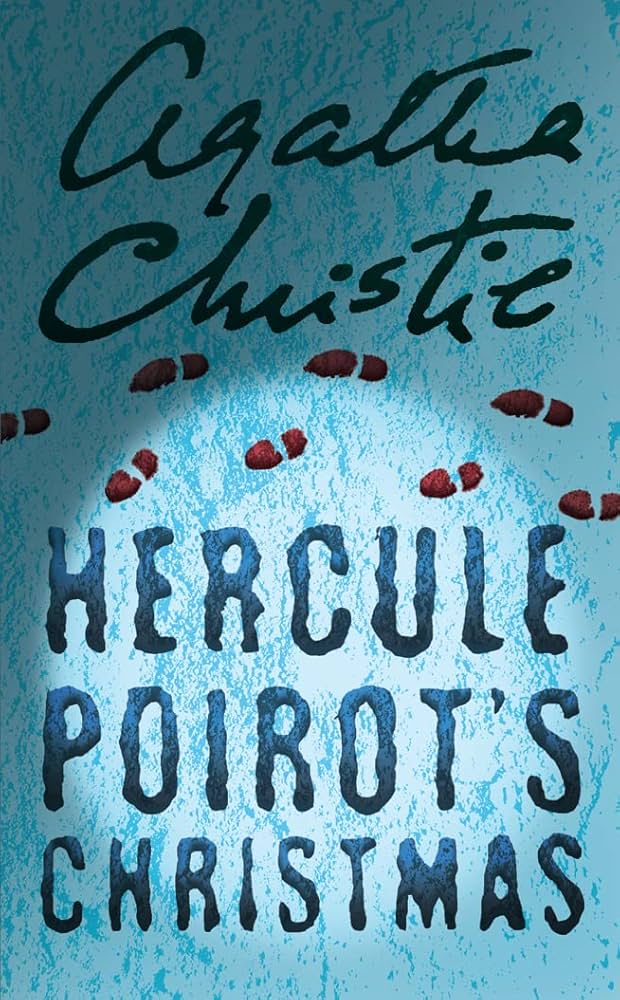
He's the recognizable kind: a patriarch who uses money as a leash, who's kept his grown children financially crippled and emotionally stunted, and who summons them all home for Christmas not out of warmth but to remind them who still holds the rope. By the time he's dead on the floor, you've met everyone and understood, uncomfortably, why any of them might have done it.
The four sons could've been cardboard, the loyal one, the bitter one, the weak one, the prodigal, but she gives each just enough grain to feel like a person. Pilar, Simeon's Spanish granddaughter who turns up uninvited, is a lovely bit of misdirection.
The locked-room mechanics are the real craft, though. The question of how that much blood ended up in the room, more than a body should hold, is one of Christie's cleverest physical problems, and the answer is simple enough to feel fair and sneaky enough to surprise. That balance is harder than she makes it look. Poirot's low-key here, more listener than showman, and the moment near the end where he walks through each clue is deeply satisfying in the way only golden-age mysteries manage. It was all in front of you. You just didn't know how to look.
It isn't top-shelf Christie, not Orient Express or And Then There Were None. The local police are thin, there to be wrong while Poirot is right, and the interview stretch in the middle gets a touch mechanical if you know her rhythms. Minor stuff.
Small odd fact: she wrote it at her brother-in-law's house, the same one that inspired the murder house in the book. She staged the killing in a room he actually owned, more or less.
Book Summary
Tyrannical millionaire Simeon Lee summons his estranged family back to Gorston Hall for Christmas, not out of warmth or sentiment, but with deliberate cruelty in mind. He taunts his sons, threatens to rewrite his will, and makes it abundantly clear that he holds every one of them in contempt. Then, on Christmas Eve, a deafening crash and a blood-curdling scream ring out from his locked bedroom upstairs. When the door is forced open, Simeon Lee is found dead on the floor, his throat slashed, lying in a shocking amount of blood, far more than anyone can account for. Hercule Poirot, who happens to be staying nearby with a friend, is called in to investigate.
What I Liked
Simeon Lee is a villain of real psychological weight, no powers, just monstrousness, which makes him scarier than most horror antagonists. The locked-room puzzle is one of her sharpest, and the central clue is both surprising and fair. The damaged-family dynamics land with unusual emotional weight. And the Christmas setting is used for irony, not decoration.
What Could Be Better
The local police are forgettable, existing mainly to be wrong. The middle interviews get repetitive once you clock the pattern, Poirot asks, someone lies, Poirot knows, on to the next. And a couple of the minor suspects are thin enough that you have to remind yourself who they are when the spotlight swings their way.
Context Behind the Book
Christie created Poirot in her very first novel back in 1920 and wrote him across 45 books and five decades, reportedly growing sick of him while readers refused to let him go. Her work has sold over a billion copies in English. She died in 1976 and has never gone out of print.