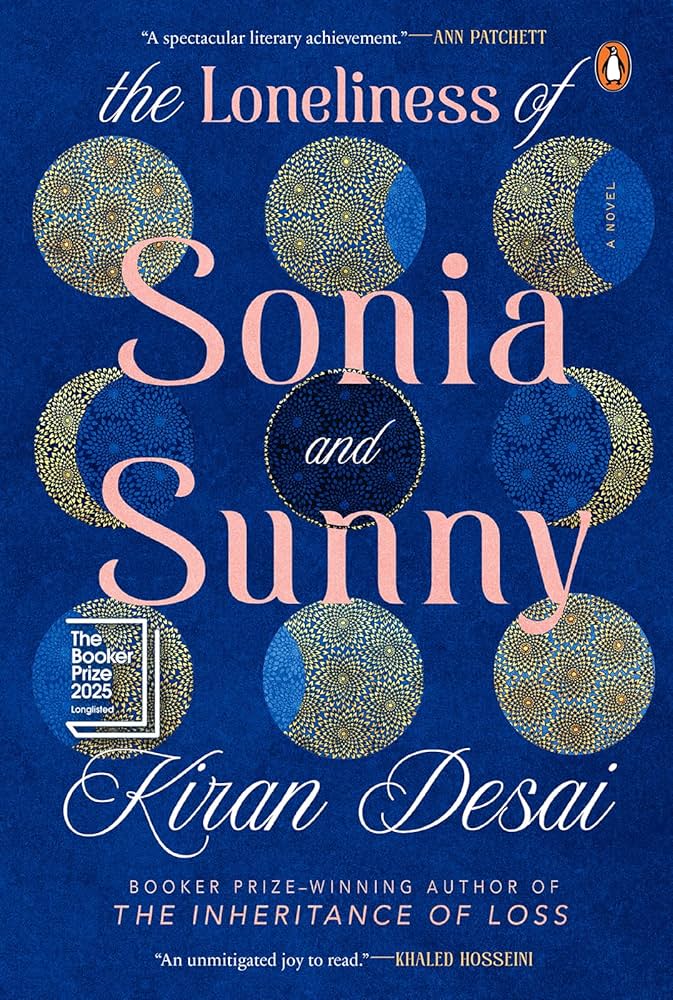
Kiran desai's second novel, the inheritance of loss, won the booker prize in 2006. Then she went quiet. Nearly twenty years passed. Readers who loved that book, and there were a great many of them, waited. Occasionally someone would report a sighting at a reading or a mention in an interview. Then in 2025, the loneliness of sonia and sunny arrived, nearly seven hundred pages long, shortlisted for the booker prize, named one of barack obama's favorite books of the year, and reviewed by the new york times book review as a transcendent triumph.
The question that precedes any review of it is whether the wait was worth it. The answer is yes, emphatically and without qualification, though not for reasons that lend themselves easily to summary.
This is a very large book in every sense. It is large in its page count, large in its ambition, large in its cast, large in the range of experience it encompasses and the number of ideas it carries. It moves between new york and india, between the 1990s and the early 2000s, between sonia's family and sunny's family and the extended, complicated world each of them comes from. It shifts registers with remarkable fluency, from comedy to grief to philosophical reflection to something approaching magical realism, sometimes within a single scene. It is the kind of novel that demands the reader's full attention and rewards it extravagantly.
The love story at the center of the book is real and felt and necessary, but calling it a love story the way you would call a lesser novel a love story does the book a disservice. Sonia and sunny are people first and lovers second, and desai is interested in all of them, in their pasts and their families and their failures and their specific, individual ways of moving through a world that keeps producing new demands they were not quite prepared for. Their romance is not the point of the novel so much as it is the lens through which the novel's actual subjects become visible: the cost of immigration, the way class moves with people across borders and continues to organize their experience in new countries, the particular loneliness of belonging fully to nowhere, the relationship between art and exploitation, the weight of family history on people who never asked to carry it.
What is most immediately striking is the prose. Desai writes with a density and a precision that requires slower reading than most contemporary literary fiction, not because it is difficult but because it is doing so much at once that rushing through it means missing the texture that makes it remarkable. A sentence about a train experience in the 1990s india will carry inside it a whole social history, a family memory, a joke, and an observation about desire, all at once, without feeling strained. That kind of writing is extremely rare. It takes time to produce, which may explain the nineteen years between novels, and it takes time to read, which the book consistently and unapologetically demands.
The novel's weaknesses, such as they are, are the weaknesses of ambition rather than of failure. At nearly seven hundred pages it inevitably has passages that work harder than others to sustain the reader's engagement, and the structural decision to move between so many characters and timelines occasionally creates a sense of dispersal that the central love story has to work hard to anchor. Some readers will find the digressions, including an extended engagement with indian literary culture and the question of what it means to write about india in english for a global audience, more interesting than others. Desai is making a case for the novel as a form capable of holding all of this, and she wins that argument, but not every page of the winning is equally compulsive.