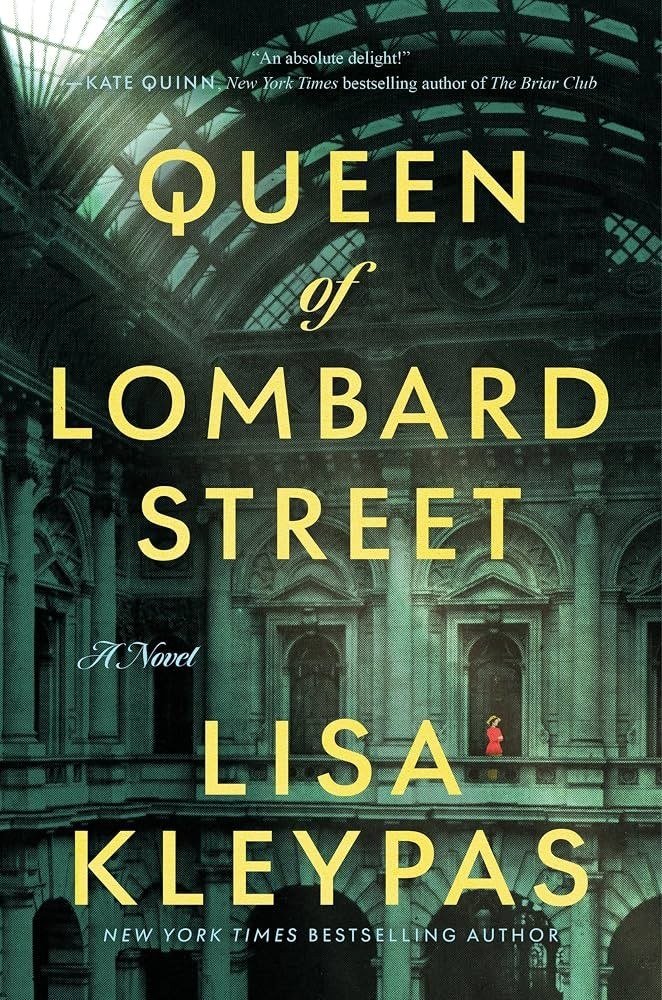
Queen of Lombard Street is most interesting when Lisa Kleypas lets money, independence, and romance occupy the same space. Reina Martin is not simply a heroine who happens to work in finance; her understanding of money has been shaped by childhood insecurity and by living in a society where women are expected to depend on men for financial protection. Her dream of creating a bank for women therefore feels personal rather than symbolic. Kleypas makes economics part of Reina’s character, which gives the historical setting more substance than a conventional society romance built mainly around gowns, parties, and marriage.
Reina’s household is another strong part of the novel. Rather than surrounding herself with polished servants, she employs people released through a second-chance program, many of whom have little experience with domestic work but plenty of reasons to need another opportunity. The arrangement creates humor, disorder, and eventually a convincing found-family dynamic. It also reflects Reina’s larger belief that people should have more control over their futures than society normally allows them. That connection between her work and private life helps the novel feel thematically consistent instead of treating the household as a separate comic subplot.
John Pembroke adds the mystery element without pushing the romance aside. He enters Reina’s home pretending to be a butler while secretly investigating William Farlow, the banker who has acted as Reina’s mentor and helped her move closer to opening the women’s bank. Reina’s attraction to John develops alongside the uncomfortable realization that helping him could destroy a man she trusts and perhaps her own professional future. I liked that their romance grows through work, suspicion, and mutual competence rather than relying only on physical chemistry. John respects Reina’s intelligence, and that matters in a novel where so many institutions are built on the assumption that women should not make important financial decisions.
The financial conspiracy gives the story useful stakes because Reina cannot solve the problem without risking something she genuinely values. Farlow is not just a distant villain she can expose without hesitation; he is connected to her ambitions and to the professional identity she has spent years building. That makes her eventual choices more complicated than a simple decision between right and wrong. The book is also interested in how financial crimes can appear respectable while quietly ruining ordinary families, which fits naturally with Reina’s determination to create institutions that give women more control over their money.
The novel does occasionally make its characters and resolutions slightly tidier than the historical setting would probably allow. Kirkus makes a similar point, noting that the carefully researched Victorian detail sits beside archetypal characters and some unusually convenient resolutions. I also think the found-family material sometimes becomes warmer and more sentimental than the financial investigation needs. Still, that generosity is clearly part of Kleypas’s style, and readers coming from her romances will probably see it as a strength rather than a weakness.
What stayed with me most was Reina’s refusal to treat ambition as something she must apologize for. The romance does not require her to become less interested in economics, abandon the women’s bank, or decide that love matters more than work. Instead, John becomes compelling partly because he understands the seriousness of what she is trying to build. Rating: 4.5/5. The plotting can be slightly convenient, but the combination of Victorian finance, romance, found family, mystery, and a heroine whose ambition remains central makes this a very satisfying return for Kleypas.
What I Liked
Reina is the strongest part of the novel because her professional ambition feels essential to who she is rather than something added to make her unusual. I also liked the balance between the financial investigation and the romance with John, especially because their attraction develops through mutual respect and shared problem-solving. The household of former prisoners adds humor and warmth without completely distracting from the larger story.
What Could Be Better
A few resolutions feel cleaner than the difficult social and financial problems surrounding them would suggest, and some supporting characters lean toward recognizable types rather than fully complicated people. The found-family sections can also become slightly sentimental compared with the sharper material about money and institutional power. These issues did not damage the story for me, but a little more messiness would have made the historical world feel even stronger.
Context Behind the Book
Lisa Kleypas is an American novelist best known for historical and contemporary romance, including the Wallflowers, Hathaways, and Ravenels series. She studied political science at Wellesley College and has published bestselling fiction for more than three decades, with her books appearing in around forty languages. Queen of Lombard Street marks a broader move into historical fiction while retaining the romance, humor, and emotionally generous character relationships associated with her earlier work. The novel draws inspiration from real historical women in economics and finance, including Mary Paley Marshall and Hetty Green.