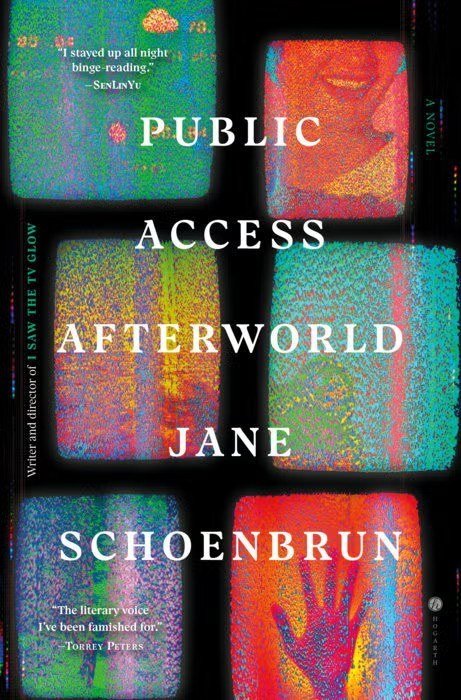
Public Access Afterworld begins with television static, but Jane Schoenbrun quickly turns that familiar image into something disturbing. David and Erin are two teenagers who already feel slightly disconnected from the world around them, so the possibility that another reality might exist behind television feels frightening and attractive at the same time. Their obsession with strange broadcasts gives the early chapters the atmosphere of an internet mystery discovered before the internet completely changed how people consumed media. Schoenbrun understands why lonely teenagers can invest enormous emotional meaning in shows, online communities, and fictional worlds that seem to understand them better than the people around them.
Bethany’s storyline gives the novel its strongest contemporary material. She spends her nights moderating horrific videos for GlobalVill, a company that resembles the enormous platforms where human workers are expected to absorb the worst parts of the internet so everyone else can scroll comfortably. When Public Access Afterworld begins appearing in the material she reviews, her job and private fears start blending together. Bethany is messy, anxious, funny, and sometimes reckless, which prevents her from becoming the perfectly prepared hero such a large speculative story might normally demand. Her gradual decision to follow the signal feels convincing because she already lives inside a system that has made ordinary reality feel slightly unreal.
The idea behind Public Access Afterworld is deliberately strange. It is a hidden dimension connected to television and creative energy, where certain people can become trapped inside stories while their imagination is extracted and turned into entertainment. Schoenbrun uses that premise to explore the relationship between audiences, corporations, creators, and the stories people cannot stop consuming. The book is clearly fascinated by television, but it is equally suspicious of what happens when art becomes endless content designed to keep people watching. That makes the supernatural horror feel connected to recognizable anxieties about streaming, social media, algorithms, and the increasingly blurry line between entertainment and identity.
The novel’s scale is both its biggest strength and its main weakness. It moves across decades, realities, media formats, conspiracy threads, queer identity, corporate technology, and American cultural history, which gives it the feeling of a story constantly discovering another hidden room. When those pieces connect, the effect is exciting because details that looked random much earlier suddenly become important. At more than six hundred pages, however, there are stretches where the mythology expands faster than the emotional story, and some readers may feel the novel could have been tighter without losing its ambition.
What keeps the book grounded is its interest in loneliness and transformation. David, Erin, and Bethany are all looking for a place where they can become more fully themselves, but Schoenbrun never assumes that escape is automatically freedom. A fictional world can save someone by giving them language for feelings they could not otherwise describe, yet it can also become another prison if living inside the story feels easier than returning to reality. That tension gives the novel more emotional weight than its complicated mythology initially suggests.
I liked the book most when the horror remained connected to ordinary media habits: watching something late at night, recognizing yourself inside a character, following a mysterious video because you need to know what happens next, or feeling that a piece of art has somehow been made specifically for you. Those experiences are familiar enough that Schoenbrun does not need to make the supernatural elements completely realistic. Rating: 4.6/5. The novel is long and occasionally overstuffed, but its combination of horror, queer identity, internet culture, television obsession, and genuine affection for people who find themselves through art makes it one of the more distinctive speculative novels of 2026.
What I Liked
Bethany is the strongest part of the novel because she feels imperfect in a way that fits the strange story around her. I also liked the mixture of old television culture and modern internet horror, especially the way Schoenbrun connects content moderation, streaming, fandom, and loneliness without making the book feel like a simple warning about technology. The mystery of Public Access Afterworld remains strange enough to create real unease even after the novel begins explaining how it works.
What Could Be Better
The book is extremely ambitious, and at 608 pages that ambition sometimes becomes excess. New mythology, timelines, conspiracies, and media references continue appearing even after the central emotional conflict is already strong enough to carry the story. A slightly tighter middle section would have made the later revelations land with more force, particularly for readers who are more interested in Bethany and the characters than in understanding every detail of the hidden world.
Context Behind the Book
Jane Schoenbrun is an American filmmaker, writer, and director known for We’re All Going to the World’s Fair and I Saw the TV Glow, films that also explore identity, loneliness, internet culture, and the powerful relationship people develop with fictional worlds. Their 2026 film Teenage Sex and Death at Camp Miasma continued their work in psychological and queer horror. Public Access Afterworld is Schoenbrun’s debut novel and expands many of the themes found in their films into a much larger story spanning television, the internet, alternate realities, and several decades of American culture.