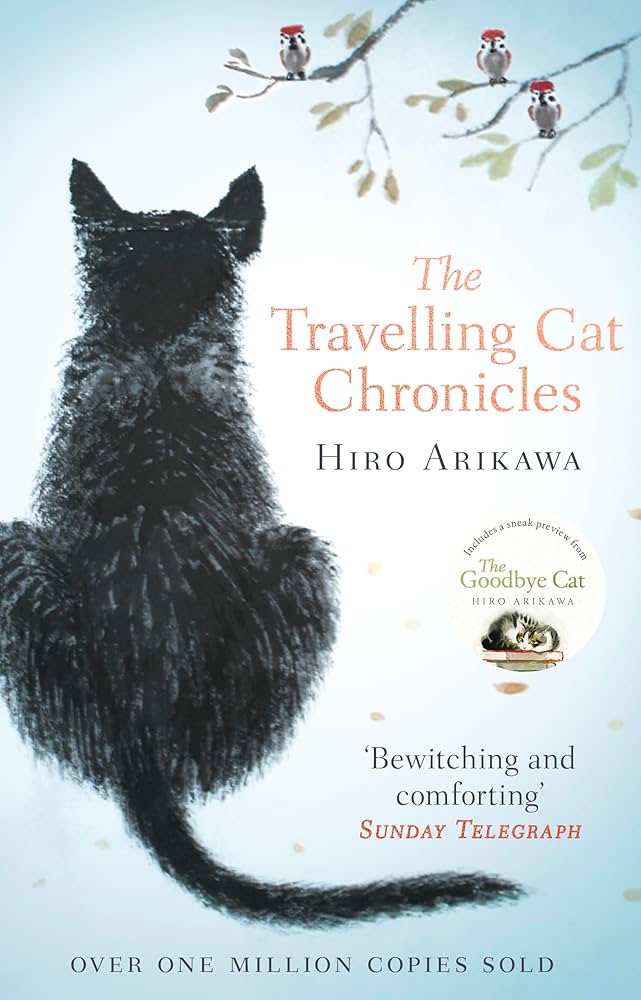
I started The Travelling Cat Chronicles because a road trip narrated partly by a cat sounded charming.
It is charming.
It is also considerably sadder than that description makes it sound.
Nana begins as a stray cat who regularly sleeps on the hood of Satoru Miyawaki’s silver van. After an accident brings them properly together, Nana becomes Satoru’s cat, although Nana would probably object to that wording. As far as he is concerned, their arrangement is much closer to a partnership between two sensible beings.
Years later, Satoru suddenly needs to find him another home.
He does not explain much more than that.
So the two of them begin traveling across Japan, visiting Satoru’s old friends to see whether one of them might be able to take Nana.
Nana, naturally, has opinions about every candidate.
His narration was what won me over first. He can be affectionate toward Satoru and still spend plenty of time judging everyone else. He notices smells, territory, other animals, open windows, and all kinds of things a human narrator would ignore. There is a slight arrogance to his voice that feels exactly right.
At the same time, Nana understands more than Satoru realizes.
That becomes increasingly important.
Each person they visit gives us another version of Satoru. One remembers him from childhood. Another knew him later. Their stories gradually fill in the parts of his life that Satoru himself does not spend much time explaining.
I liked that approach because Satoru could easily have become almost impossibly nice if the book simply told us how kind he was. Instead, we see small examples of it spread across years.
He remembers people.
He helps without making a performance of helping.
He carries losses without turning them into reasons to become bitter.
There is something slightly unusual about learning the central human character this way. Satoru is physically present throughout the journey, yet much of his personality arrives through memories belonging to other people.
It made him feel both close and strangely difficult to reach.
The road trip itself has a gentle rhythm. They drive, arrive somewhere new, meet an old friend, and spend time in another corner of Satoru’s past. The landscape changes with them, giving the book an almost episodic quality.
Normally, that structure might have started feeling repetitive to me.
Here it worked because every visit changed what I understood about the journey.
Fairly early on, I began to suspect that Satoru was hiding something serious. The novel is not particularly interested in fooling the reader forever, and I think that is the right choice. The tension comes less from discovering the secret than from watching Nana move closer to understanding it.
That is where the story became much more emotional for me.
Nana and Satoru do not need huge declarations to make their relationship convincing. Their affection has already been established through car rides, habits, complaints, and all the little routines people develop with animals.
Anyone who has lived with a cat will probably recognize some of this.
You can feed a cat every day, provide the house, pay the veterinary bills, and still somehow get the impression that the cat believes you were the one fortunate enough to be selected.
Nana absolutely has that attitude.
And yet his loyalty to Satoru is never in doubt.
That mixture of independence and attachment is one reason the later parts work as well as they do. Nana is not simply a cute companion placed into the story to make Satoru more sympathetic. He has his own understanding of home, belonging, and who he wants to stay beside.
The book gets more openly sentimental as the reason for the journey becomes clear.
This worked for me most of the time, though not always.
There were places where I could almost see the emotional scene being prepared. Satoru’s friendships fit together very neatly, each visit revealing another useful piece of his character. A few moments are so clearly designed to break your heart that I became slightly resistant to them.
I would have preferred a little more mess.
Real friendships do not always resolve themselves at exactly the moment someone needs closure. Memories are rarely arranged into such convenient chapters. The book occasionally smooths those rough edges because it knows where it wants everyone to end up.
Still, the emotion underneath it never felt completely false.
Part of that is because the novel understands something simple about losing an animal—or being separated from one. The relationship can look small from outside. Feeding them. Opening a door. Hearing paws somewhere in the house. Making room beside you without really thinking about it.
Then one day those routines are gone, and the empty spaces suddenly seem enormous.
The final part of The Travelling Cat Chronicles leans directly into that feeling.
I knew where it was heading. That did not help very much.
What stayed with me afterward was not really the twist behind the journey. It was the idea of home the book builds along the way. For Nana, home is not necessarily a particular house or landscape. It is connected to the person beside him.
Satoru seems to understand something similar.
The novel can be sentimental, and its structure is a little too tidy for me in places. But I found it difficult to hold those complaints against a story that made the relationship at its center feel so simple and convincing.
In the end, The Travelling Cat Chronicles is less about a man searching for someone to take his cat than it is about two companions trying, in very different ways, not to leave each other.
And yes, the cat gets some of the best lines.