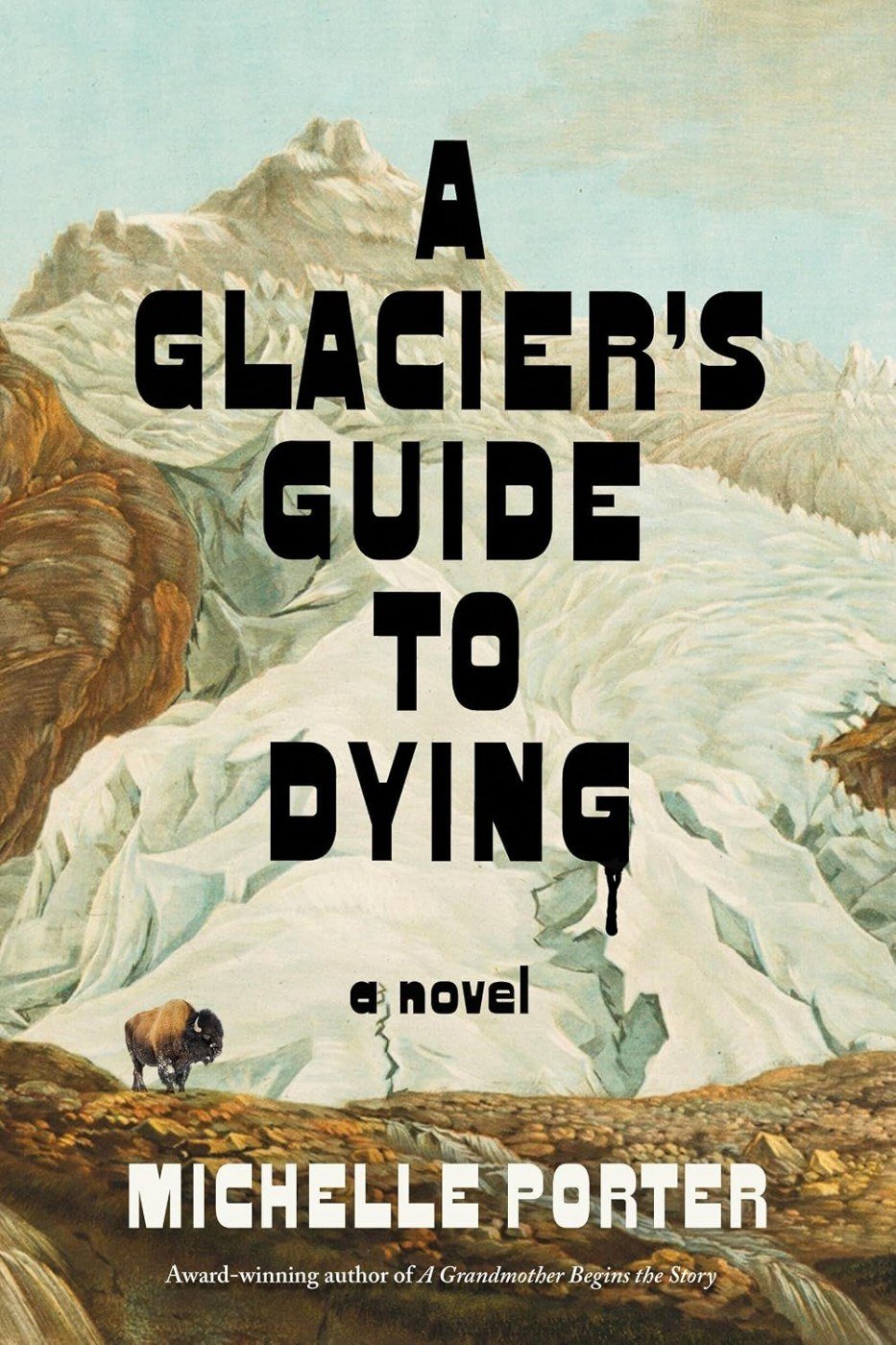
A Glacier’s Guide to Dying has a premise that could easily have become either a family mystery or a climate-change parable, but Michelle Porter tries to make it both at once. Robbie’s search for his missing father gives the novel an immediate emotional direction, while the spreading wildfires and retreating glaciers turn that private search into something much larger. The strongest idea in the book is that environmental loss and family loss are not separate experiences. Robbie is looking for a person who disappeared from his life while moving through a landscape that is also disappearing around him.
Robbie is an appealing center because he is carrying several kinds of inheritance he does not completely understand. His connection to his Métis family, his father’s visions, his musical ability, and the violence and instability of his childhood all shape how he interprets what is happening. Porter is especially interested in the uncomfortable possibility that something can be spiritual, psychological, cultural, and frightening at the same time. When Robbie begins hearing the glacier, the novel wisely does not rush to give a clean explanation.
The relationship with his father gives the climate material its emotional weight. Mike has been absent long enough that Robbie’s search is partly for the real man and partly for the version of him Robbie has been carrying in his imagination. That distinction matters because finding someone does not necessarily repair what their absence has done. The novel keeps returning to the question of what children inherit from parents besides names or physical features: fear, stories, unfinished pain, ways of understanding the world, and sometimes responsibilities they never asked to carry.
The landscape becomes increasingly active as the novel moves into Montana. Wildfires turn roads and communities chaotic, while the glacier is treated not simply as scenery but as something with age, memory, and presence. That is where Porter’s magical realism is most interesting. The glacier speaking to Robbie could have felt overly symbolic, but the uncertainty around what he is actually experiencing keeps the idea alive. The novel is less interested in proving that nature literally has a voice than in asking what changes when a person finally stops treating the land as silent.
The execution is not always as controlled as the ideas. Publishers Weekly raised concerns about continuity problems and underdeveloped storytelling, and those criticisms are difficult to ignore when considering the novel as a whole. Several large subjects—family violence, mental illness, Métis identity, ecological grief, wildfire, inheritance, and magical realism—are competing for space inside a relatively short book. At times the transitions between them feel quicker than the emotional material deserves, and a few developments seem to arrive before the earlier ones have fully settled.
That unevenness does not erase what works. Porter has an unusual ability to place humor beside grief without making either one feel false, and Robbie’s journey remains compelling because the book never reduces him to a symbol of climate anxiety or generational trauma. The best passages allow family, landscape, and identity to overlap naturally rather than explaining exactly what each element represents. The weaker moments are usually the ones where the novel seems to hurry toward its next large idea.
What I Liked
The connection between Robbie’s missing father and the disappearing natural world is the novel’s strongest idea. I also liked the uncertainty around Robbie hearing the glacier, because Porter avoids reducing the experience to either a supernatural event or a medical explanation. The combination of Métis identity, family history, music, wildfire, and ecological grief gives the story a character that feels very different from more conventional climate fiction.
What Could Be Better
The novel tries to carry so many themes in 272 pages that some of them do not receive enough room to develop. Certain transitions and plot developments can feel abrupt, and the continuity concerns raised by Publishers Weekly point to a broader problem with structural control. A slightly longer or more tightly edited version could have allowed the family story and the magical-realism elements to connect more naturally.
Context Behind the Book
Michelle Porter is a Métis writer and member of the Manitoba Métis Federation. Her debut novel, A Grandmother Begins the Story, won the 2024 Thomas Raddall Atlantic Fiction Award and was a finalist for the Atwood Gibson Writers’ Trust Fiction Prize. Her earlier books include the memoir Scratching River and Approaching Fire, a work of creative nonfiction about her great-grandfather and Métis fiddling traditions. Porter lives in St. John’s, Newfoundland and Labrador, where she teaches creative writing and Métis literature at Memorial University.