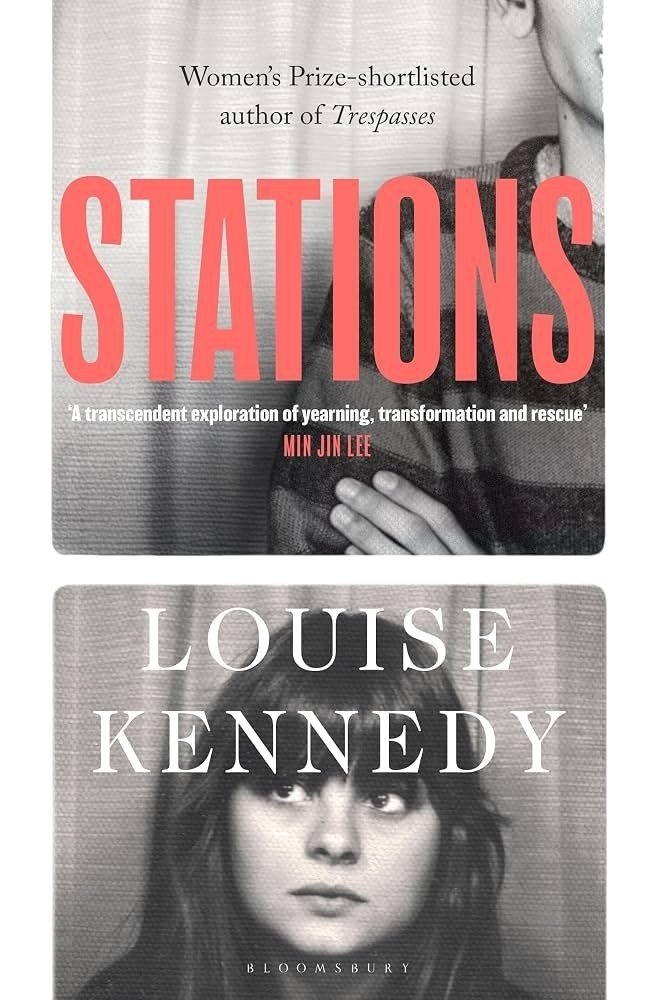
Stations understands something uncomfortable about first love: sometimes the person who changes your life is not the person capable of sharing it with you. Róisín meets Red when both are teenagers carrying different forms of shame and anger, and their friendship quickly becomes a refuge from families they do not fully understand. Kennedy avoids making their connection overly romantic at the beginning. They are funny together, difficult together, and drawn to the feeling that the other person sees something everyone else misses.
Róisín is the stronger character because she is allowed to be both perceptive and spectacularly bad at protecting herself. Her fascination with Red is not simply attraction; he becomes connected to youth, rebellion, escape, and the possibility that another life exists somewhere beyond the narrow world she knows. That makes her attachment harder to abandon even after it becomes obvious that Red cannot give her what she wants. Kennedy never asks us to mistake obsession for destiny, and that distinction keeps the novel emotionally honest.
The London sections are especially effective. Róisín enters a squat where Irish migrants, drifters, workers, lovers, and damaged young people are trying to survive without much money or certainty. The setting captures both the freedom and the desperation of leaving home. England offers escape from Ireland, but not necessarily safety, stability, or belonging. Kennedy makes migration feel less like a clean departure and more like carrying one country inside another.
Red remains deliberately difficult to fully know. He is intelligent, charismatic, funny, damaged, and increasingly self-destructive, but the novel resists turning his suffering into something beautiful. Róisín often wants to rescue him because rescuing him would also justify the years she has spent believing their connection must eventually become something more. The book is strongest when it exposes that fantasy without humiliating her for having believed in it.
There is also a larger social history running underneath the relationship. The novel touches on unemployment, Irish migration to Britain, family shame, religion, addiction, and the limitations surrounding divorce and legitimacy in Ireland during the period. None of this feels pasted onto the story because Kennedy keeps the politics inside ordinary decisions. A family argument or an administrative rule can alter someone’s life just as decisively as a dramatic event.
My only reservation is that Red’s distance is sometimes so complete that he risks becoming more powerful as an absence than as a fully available character. That is partly intentional—the novel is about what Róisín projects onto him—but there were moments where I wanted slightly more access to the person behind the mythology. A few of the later time shifts also move quickly enough that important emotional changes can feel compressed.
What I Liked
Róisín is the book’s greatest strength. Her feelings for Red are intense, frustrating, understandable, and sometimes self-destructive, which makes her feel far more real than a heroine built around a neat romantic arc. I also liked the London squat material and the way Kennedy connects personal instability with the wider experience of Irish migration without turning the novel into a history lesson.
What Could Be Better
Red is intentionally elusive, but that distance occasionally makes him feel more like an emotional force in Róisín’s life than a fully visible person. Some later periods also pass quickly, and I would have liked slightly more space around the changes in Róisín’s adult life. These are relatively small complaints in a novel whose emotional control is otherwise very strong.
Context Behind the Book
Louise Kennedy grew up near Belfast and spent almost thirty years working as a chef before beginning her literary career. Her story collection The End of the World Is a Cul de Sac won the John McGahern Prize, while her debut novel Trespasses became an international bestseller, won multiple awards, and was shortlisted for the Women’s Prize for Fiction. Stations is her second novel and returns to themes of Ireland, political and social pressure, complicated intimacy, and the consequences people carry long after a particular moment has passed.