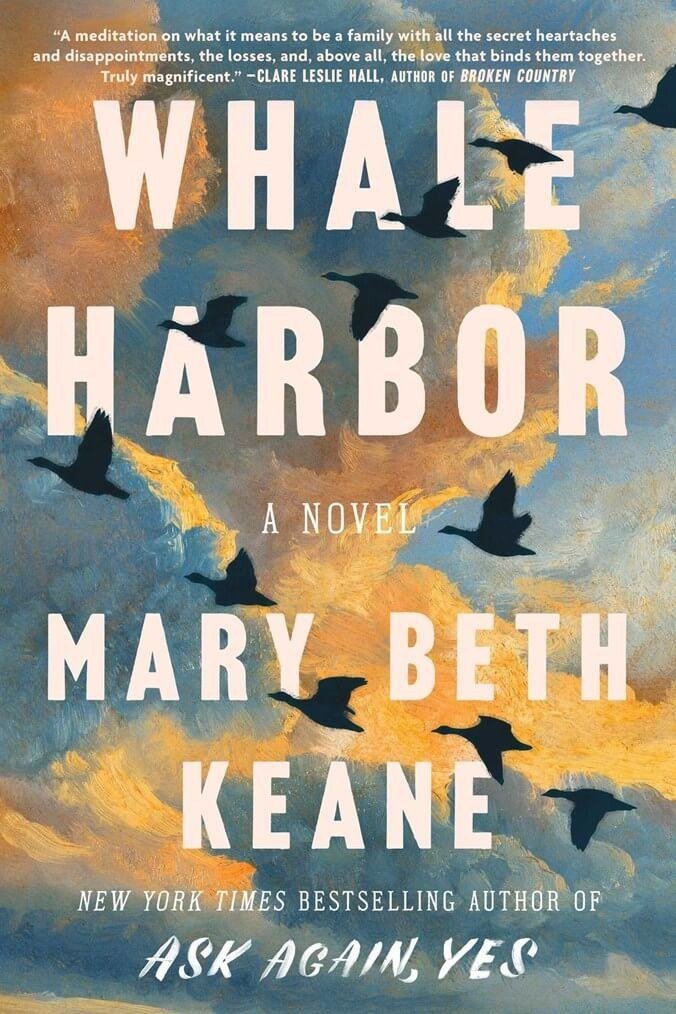
Whale Harbor begins with a family already accustomed to hardship, but Mary Joyce’s death changes the shape of everything that follows. With eleven sons and a father who is unreliable even before tragedy strikes, the boys are quickly divided by circumstance. Some are sent to England for work, others remain in Ireland, and Macdara is offered an unexpected route to America. Keane does not treat migration as a clean escape from poverty; every opportunity comes with a separation attached to it, and Mac’s decision to leave Rian behind becomes the emotional wound the novel keeps returning to.
Mac is a strong center for such a large family saga because he is not especially expressive. He works, adapts, builds a life, and rarely says everything he is carrying, but guilt over Rian follows him from the ranches of Montana into immigrant life in New York. That restraint makes the story more effective than if he constantly explained his grief. Keane is especially good at showing how an old regret can remain present inside an otherwise successful life, affecting marriage, parenthood, and the way someone responds to every piece of family news.
The movement between Ireland, Montana, and New York gives the novel a wide geographical range without losing its focus on family. The Irish village feels small enough that everyone knows everyone else’s history, while Montana offers Mac enormous physical space without giving him much emotional freedom. New York is different again, full of brothers, wives, children, jobs, apartments, and the noisy practical work of building immigrant lives. The settings change, but the Joyce family keeps carrying the same unresolved history with them.
The eleven brothers could easily have become confusing, yet Keane mostly avoids that problem by keeping the emotional weight centered on Mac and Rian while allowing the larger family to grow around them. The book is interested in brotherhood as something affectionate but also demanding. Leaving home may be necessary, but the person who leaves can still feel responsible for the people who stayed behind. That tension gives the family story more depth than simple nostalgia about Ireland or immigration success.
The novel slows somewhat in the middle when decades of work, marriage, children, and smaller family struggles begin accumulating. Historical Novel Society raised a similar reservation, noting that some sections meander before the central emotional tension strengthens again. I felt that too, but the quieter material also helps the later chapters land because we have seen how much life Mac has built while still carrying the same unresolved promise.
What stayed with me most was the novel’s understanding that leaving home is rarely one clean act. Mac leaves Ireland physically, but part of him remains tied to the brother he abandoned, the mother he lost, and the village that formed him. Keane turns that guilt into something larger than one family secret: a story about immigration, responsibility, and the strange way people can build entirely new lives without ever fully escaping the old ones. Rating: 4.6/5. The middle could be slightly tighter, but the emotional payoff, family relationships, and sense of place make Whale Harbor a deeply satisfying multigenerational novel.
What I Liked
Mac and Rian’s relationship gives the novel a strong emotional center without requiring constant dramatic confrontation. I also liked the way Ireland, Montana, and New York each feel distinct while remaining connected through the Joyce family. Keane writes immigration as both opportunity and loss, and the large family never feels like a simple background crowd. The later payoff works because the guilt and distance have been allowed to accumulate naturally over decades.
What Could Be Better
The middle portion occasionally loses momentum as the novel moves through marriages, jobs, children, and smaller family events. With eleven brothers and several generations, some supporting characters naturally receive less depth than others. A slightly tighter structure could have kept the focus on Mac and Rian sharper without sacrificing the sense of a large family spreading across countries.
Context Behind the Book
Mary Beth Keane is an American novelist born in the Bronx to parents from the west of Ireland. Her books include The Walking People, Fever, Ask Again, Yes, The Half Moon, and Whale Harbor. She has received a John Simon Guggenheim Fellowship and recognition from organizations including the National Book Foundation and PEN America. Whale Harbor, her fifth novel, draws partly on aspects of her own family history while remaining a work of fiction.